Coach and Youth Soccer Player
2-3-1 Soccer Formation Masterclass: 6 patterns of Play

Let’s break down the 2–3–1 soccer formation, the most common and most effective setup for 7v7 soccer. But instead of just telling you where players stand, I want to give you something much more useful: a development framework.

We’re going to look at:

  1. The formation and every position in it. How to set it up so it works both for results and for development.
  2. How the 2–3–1 fits into the long-term growth of players—from 4v4, to 7v7, to 9v9, and eventually 11v11. It’s not up to the players to know this at their age, or even for the parents. But the coach must.
  3. And finally, real, simple 6 key patterns of play that U9 and U10 players can actually understand and execute.

PART 1 — THE 2-3-1 SOCCER FORMATION & WHAT EACH POSITION DOES

The 2–3–1 is built on three simple ideas:
Width, depth, and support.
It creates a shape that’s easy to understand but gives players clear reference points to solve problems during the game.

Goalkeeper

At U9 and U10, the goalkeeper is not just a shot-stopper.
They’re the start of your build-up.

Their key jobs:

  • Give a safe option behind the center backs
  • Distribute short as the first choice
  • Play with a higher starting position to sweep long balls

You don’t need a tiny Manuel Neuer back there—just someone willing to make simple decisions and stay connected to the team.

The Two Center Backs

These two players form the backbone of the formation.

Their key habits:
Stay connected—roughly 5 to 7 yards apart.
If one steps to the ball, the other provides cover. If you play in a 3-2-1 formation, you will have only one central defender that will not have a partner to learn this with.
This teaches the basic “pressure–cover” defensive principle they’ll use for the rest of their soccer life.

In possession, teach them to:

  • Receive the ball wide of the goalkeeper
  • Play simple passes into midfield
  • Avoid dribbling forward unless there’s no pressure at all

This is also the age where they start understanding angles and body shape—so get them comfortable opening up and playing forward. When we attack, they should be allowed, and encouraged, to go all the way to the center of the field.

The Three Midfielders

This is where the formation really shines.

You have:
Left Midfielder, Center Mid, Right Midfielder.

Let’s start with the outside players.

Left and Right Midfielders

Their role is simple:
Be the width.

Wingers stretch the field horizontally, and that creates space for everyone else. The best way to explain this is to have the limit of left midfielder staying on the left side of the field, and the right midfielder on the right half.

They should:

  • Stay wide early in build-up
  • Drive forward with the ball when space opens
  • Track back to help defensively on their side
  • Combine with the striker in attacking transitions

For many players, these are the most fun positions—they get to dribble, run, and make things happen.

Center Midfielder

This position is the heartbeat of your 2–3–1.

This player controls the game with two responsibilities:
connect and protect.

They connect defenders to attackers, and they protect the middle of the field on defense. They will be under the most pressure, but also develop the fastest because they will have the most player actions per unit time.

The most important thing to teach your CM is:
Stay central. Don’t chase the ball everywhere.
Kids this age want to follow the ball like a magnet—so give them the confidence that their job is to hold the middle and appear as the option when everyone else needs support.

They’re also your switch player. When the left side is crowded, find the CM and then play to the right. Keep it simple.

The Striker

At U9 and U10, the striker isn’t just someone who scores.
They are the player who gives your team depth.

Their key jobs:

  • Stay high enough to stretch the field
  • Check toward the ball at the right moment
  • Provide a clean layoff pass
  • Press the opposition center backs on turnovers

This age group tends to have forwards who love drifting back into midfield.
You want the opposite:
“Stay high until the ball comes near you. Create space first.”

The beauty of the 2–3–1 is that this striker is rarely isolated—they almost always have passing options on both sides and behind.

PART 2 — HOW 2–3–1 SOCCER FORMATION FITS LONG-TERM DEVELOPMENT

One thing I always emphasize:
Formations are not about winning youth games.
They are about giving players a foundation for their future.

Here’s how 2–3–1 fits into the bigger picture.

From 4v4 → 7v7

At U8 and below, players learn the basics:

  • Dribbling
  • 1v1
  • Using space
  • Quick decisions
  • Shooting often

There’s usually a diamond in the 4v4 format: one back, two wide, one forward. This means that they have three passing options, in addition to the opportunity to dribble.
The 2–3–1 soccer formation simply takes that diamond and adds an extra layer of support.

It introduces:

  • Lines of players
  • Angles of support
  • Width with responsibility
  • Organized build-up
  • Roles without rigidity

This is exactly what 7v7 should be—a bridge, not a destination.

Preparing for 9v9 from the 2-3-1 soccer formation

Most clubs play some variations of 3–2–3 or 2–3–2-1 in 9v9.
The 2–3–1 transitions naturally into those shapes.

Center backs → become part of a back three or back 4.
Wide midfielders → become fullbacks or wingers.
Central Midfielder → becomes either the #6, the #8 or the #10.
Striker → becomes the 9 or part of a front two.

When you coach the 2–3–1 well, players don’t feel lost when they move to 9v9.
They already know spacing, width, depth, and how to keep good team shape.

Preparing for 11v11

Finally, the big field.

The 2–3–1 naturally teaches elements of:

  • A back four – they learned how to work in pairs with pressure and cover methodology.
  • The fullbacks learned to defend, but also push forward. They kept the same lesson from 2-3-1 soccer formation.
  • The central midfielder wore lots of hats and roles, so that they can understand the 6, 8 and 10 roles.
  • Wide players who understand width, but also understand the cutback benefit.
  • A central striker who understands timing, holdup play and even dropping deep.

Kids who grow up with this formation understand the skeleton of 11v11:
Center backs who work together, wingers who stretch the field, and a midfield core that supports both defense and attack.

If you teach the habits now, the tactical jump to 11v11 is smooth.

PART 3 — PATTERNS OF PLAY FOR U9–U10 (SIMPLE & EFFECTIVE)

Patterns of play at this age shouldn’t be complicated. You don’t want rehearsed choreography. What you want is simple, repeatable habits that help kids understand how to move and combine. Here are the most effective ones.

Pattern 1: One-two or give-and-go

This is the simplest attacking structure. In this case, one player is a support to the other. Instead of dribbling, the winger decides to pass to the center-mid, and make a run forward to receive the ball behind their defender. Then, they repeat the same pattern with the striker as the supporting act. I coach rondos to teach passing, but the movement must go along with it. That’s why I do double rondos and possession games.

Coaching points:

  • The support player first touch should be soft
  • Winger runs immediately after the pass
  • The pass cannot be too early – the winger must attract the pressure from their defender

Kids love this one because it feels like “real soccer.”

There is a video on the one-two pattern on the channel. Check it out after finishing this video – here’s the the link.

Pattern 2: Third-man passing

This is your basic triangle. Essentially, the center mid is a support, or also called third-man player. The center back wants to pass to the winger who is open, but that potential pass is blocked by an opponent. Instead, the center mid sees that intention, and acts as a support.

This pattern can be seen in other areas, too. Here’s another example, the center mid wants to pass to the striker, but there is simply no clear passing lane. Then the winger can act as the support and enable that pass.

Teach players to:

  • Check to the ball
  • Open up
  • Play quickly into space
  • Support after the pass

This pattern teaches spacing better than any drill. I’ve done a long video on this pattern that you can see in professional games, here’s the link to it.

Pattern 3: Defensive line change sides

When we are attacking on the left, the left winger might go all the way forward, and the left center-back becomes a fullback. The right center back comes more centrally and the right winger becomes a right fullback. To give freedom to the winger, the entire back line has to shift a bit to provide cover. The center mid here can have more freedom to support the attack because the back line provides both offensive and potentially defensive support. Look at how this line will shift to the other side if the ball also shifts. The right winger pushes and is no longer a fullback. The other three players dropped and shifted to the right, too. This is something we see from these 8 year olds all the way to professional teams, so learn it early.

Pattern 4: Counter-attacks in the 2-3-1 soccer formation

When attacking, the more attacking players can take positions from others if the space is there. For example, if the team is defending and clears the ball to the side, then the striker can get the ball and become a winger in this counter attack. It is up to the winger to claim the striker role and attack through the middle, instead of overcrowding the wing.

But let’s say that the winger is not moving fast enough for this counter attack. Should the center mid exploit the space for a counter attack? Absolutely! Then it is up to the winger to notice that and adjust by taking the central position in the midfield. As you can see, there was a rotation of these there players’ position for this attack. Afterwards, they will switch back, but for now we will attack with the players in these roles because that’s available.

The important habits here are:

  • Attacking players exploit space
  • More defensive players keep the structure
  • The play stays predictable and safe in case there is loss of possession

Kids build confidence fast when they know where their options are.

Pattern 5: Defensive Shape With Covering

On defense, the position switch is forced, not opportunistically taken. This is not a permanent position change—just a recovery pattern. Let’s say the ball is lost and winger has lost the duel. The CBs are exposed with one of them covering for the winger. One option is for the other CB to shift more centrally and for the other winger to also drop in the defensive shape. That often is not fast enough. Instead, the CM drops into the gap of the central defenders to help until the team is organized again. This is a temporary delay until the two wingers recover to the right positions. Often times, the winger who was initially beaten, comes to the central midfield because it’s faster than coming all the way as a center back. As you can see, this is another triangle rotation, but in defense instead of offense.

This teaches:

  • Cover
  • Compactness
  • Responsibility when the ball is lost

Again, keep it simple. Just “drop and protect the middle.”

Pattern 6: Pressing Trigger in the 2-3-1 Soccer Formation

Finally, pressing at youth levels is extremely effective. The very basic high press:

  • Striker presses the opponent’s center back and blocks the pass to the other defender and keeper
  • Winger closes the fullback to prevent the simple outlet pass
  • CM steps up to block the passing lane inside

Kids love pressing because it feels aggressive and exciting. Just keep it organized with simple rules. The important part is for players to learn to think like the opponent. What does the opponent hate the most? Lack of options and increased pressure. This thought pattern needs to become second nature for the players, so it’s important to start early and understand how they work as a team to find the pressing triggers. Check out the video that I made specifically for this pattern.

CONCLUSION

So that’s the full look at the 2–3–1 formation.

It’s clean, it’s simple, and most importantly—it’s development-first.

It gives your players a framework they can actually understand, while teaching the core habits of real soccer:
width, depth, support, pressure, and transitions.

If you coach these ideas consistently, your players will be confident and ready for 9v9 and eventually 11v11.
U5-U8 Soccer Drills
Best U5–U8 Soccer Drills (That Actually Work)

The Real Goal of Coaching U5-U8 Soccer Drills

I have been coaching youth soccer for many years, but this year I got a group of 5 years old kids for the first time. Let me share with you all the things you need to know when coaching them. As always, I will share these u5-u8 soccer drills that worked for me. But also, I will talk a bit about the approach to take with the players at this age, such as tricks to get them organized and attentive, while also engaged in soccer activities.

Let’s define the goal – at U5, U6, U7 and U8, remember one simple objective: it’s not about getting their attention to do as you say – it’s about getting them to do soccer things. At this age, most kids won’t “learn” from your explanations. They’ll learn from doing. Your job isn’t to make them listen perfectly — it’s to make sure they’re moving, touching the ball, and having fun doing soccer-related actions. Even if they ignore you half the time, if they dribble, shoot, chase, and play, they’re developing the foundation they need for later years.

Attention Span Limit

The challenge for you is to convey whatever message in 10 or 15 seconds max. If you can’t, then either simplify the drill or the concept, or practice giving instructions in 10 seconds outside of practice. I do have some tricks for keeping attention, which can be a struggle for even 10 to 15 seconds – I share them at the end of the video. For most of the players, you are the first and potentially only window into the soccer world. So, in a way they equate you with soccer. You can make them fall in love with soccer or make them hate it. So keep that in mind as we go through these drills — they’re all about doing soccer things, not doing other things and not just standing and talking about soccer things.

No-Opponent U5-U8 Soccer Drills

The first group of drills is no-opponent drills. The gap between the players is likely very large as the only thing common for them is the area whey they live and roughly the age. So some naturally athletic kid that played for 6 months, will look miles ahead of another kid who never played soccer. For this, here are several drills where every kid has a ball and is taking time to get familiarized with it during practice. At this age, make a story out of it, to make it more fun for the kids.

1. Gates Dribbling

Set up small gates all around the field — two cones about a yard apart. Players need to dribble through as many gates as they can in a set time. It sounds easy, but for beginners, even keeping the ball close enough to get through a gate is a challenge. This develops basic dribbling control, awareness, and soft touches — in a way that feels like a game.

2. Volcanoes

Cones are volcanoes, and players need to stop the lava by placing their ball on top of the cone. You need those cones where the top is cut. This is great for teaching ball control and familiarity. It’s not intense — kids love it because it feels like a game, not a drill. Perfect for warming up or resetting focus if they start getting tired or distracted. They will roll the ball a bit, as well as slow down before a cone. If they don’t like this game within few weeks, it means they experienced enough of competition, and find that to be the exciting part of the game.

3. Follow the Leader

Make a large square — maybe around the size of the penalty box. One player is the leader, and everyone else follows. Start without a ball so they learn spacing and movement, then add the ball and make it a dribbling game. The goal is for them to control the ball while keeping pace with the leader. You can switch leaders often to keep everyone involved and active.

4. River of Cones

Set up a “river” — a path of cones with a clear dribbling lane between them. Players dribble through the river, staying inside the boundaries. Later, you can add “rocks” or “obstacles” (extra cones) they must avoid. At the end, add a small goal — they dribble, avoid cones, and shoot.
This combines coordination, control, and finishing — three soccer actions in one sequence.

5. Dribble and Do a Trick

This one builds skill and quick reactions. While everyone’s dribbling around, yell out a command. At the first practice, start simple — “Stop the ball”, or “Switch feet!” Next time, add a trick: “Pull back!” or “Pull-push!” Each week, introduce one new move. It keeps them challenged and gives structure to their development — but it’s still fun and reactive.

U5-U8 Soccer Drills with Opponents

Let’s now talk about drills with opponents. For older players I almost exclusively do drills with opponents, although they don’t have to be even sides. As you can see on the channel, there are lots of rondos, passing or possession games where one team has more players. This method of teaching is also called scaffolding, where you are creating the environment to make certain aspect easier until the players are proficient enough to increase the challenge to a level closer to the real game.

6. Races with the ball!

There is no defense in these drills and they are perfect transitions between the no-opponent and the opponent games. Kids love to race, especially at this age. They know that instinctively, unlike soccer that is still a more structured and unfamiliar to them. You can simply have races around a cone, then both players shoot on a goal. The objective is to score the goal first. You can control a lot in this races, where just one change, such as position of the goals, the cones or the starting point, can change the challenge. They might need to practice a pull back or a change in direction, as the most optimal move.

7. 1v1 or 2v2 Mini Games

I will not go through a practice without 1v1 or 2v2 games. Make sure both sides have a fair chance to score, and adjust the size of the field or goals if one side is dominating. You want every kid to feel like a winner, even if the score doesn’t say it. This teaches competitiveness, direction, and the joy of scoring goals — all without needing to explain tactics or positioning. I sometimes add something special that I want to coach – for example, I roll the ball to them, so they practice receiving.

Here is what I did at one of the last practices – they need to receive the ball and go sideways to one of the goals while the defender is challenging them. It’s something that I’ve seen they struggle in a game with receiving a loose ball, so I integrated it into a drill without them even really knowing.

8. River with Sharks

This is their first taste of passing. Don’t do this at the first practice if they are new players – I tried it, and it didn’t work. They need a bit of ball control. Set three zones, where the middle is called the river, with one group is on each side. Players must pass the ball across the river without letting the shark — that’s you — intercept it. Kids love it because it’s a challenge. You can start easy and make it harder over time — move the shark, add more players as the sharks, or make the passes longer.

9. Bring the Ball Back

Scatter balls around the field — far away from the goal. Tell them they have to “rescue” the balls, bring them back, and shoot to score. At first, everyone has a ball. Later, have fewer balls than players so they have to race and compete to get one. It’s simple, but it builds ball control, direction, and the idea of attacking a goal — all while feeling like a mission. Similarly to some of the other drills, I modify this drill be me kicking the ball towards them to receive it. They simply don’t practice receiving that much at this age, and they struggle in games by kicking it blindly. So I create the situation to train that at practice.

Attention & Coaching Tricks

Now, no matter how good your drills are, there will be moments when things get chaotic.
Here are a few coaching hacks to help keep control — without shouting. I have learned them through the years by observing other coaches and seeing what works and what doesn’t. Obviously, I am sharing the ones most appropriate for the youngest players here.

A. The Countdown Rule

When you need everyone’s attention, start counting down from 5. Kids love racing against the clock and with each other. They’ll rush to finish and gather up before you hit “1.”

B. The 10-Second Rule

When you say “10 seconds,” it tells players that you’ll only talk for 10 seconds — and they can focus that long. It forces you to be concise, and them to listen. If you can’t explain it in 10 seconds, simplify the drill. And make sure you don’t get carried away because they gave you the attention – don’t break your promise.

C. The Runaway Trick

If things are getting silly and players stop listening, don’t yell — just start running. Sprint 10 or 15 yards away and shout, “Race me!” or “who can catch me?”. They’ll instantly chase you. Once you’ve got their attention back, reset the group and move on. You can also find a reference point, so instead of chasing you, the challenge can be to race around the goal, or race to the other goal where they will get the next instruction.

These tricks reset their energy, break the chaos, and get you back to doing soccer things.

Conclusion

At the U5–U8 level, remember — it’s not about running the perfect session or teaching tactics.
It’s about giving kids as many touches and moments of joy with the ball as possible. If they’re laughing, running, and kicking the ball — that’s success. Because before they can learn soccer, they have to love soccer.

Relative Age Effect in Soccer
Relative Age Effect in Soccer – Why Some Kids Get Left Behind

Have you ever noticed that the best players on a youth soccer team are often the oldest ones in their age group? That’s not a coincidence. It’s something called relative age effect in soccer, and it has a massive impact on which kids succeed, who gets overlooked, and even who quits the sport altogether and not because of the harsh conditions on the soccer field. In this video, I’ll explain what relative age is, why it matters so much in soccer, and most importantly—what we can do about it.

What is Relative Age Effect?

Relative age is the difference in development between two players who practically fall into the same age group, but are born months apart.

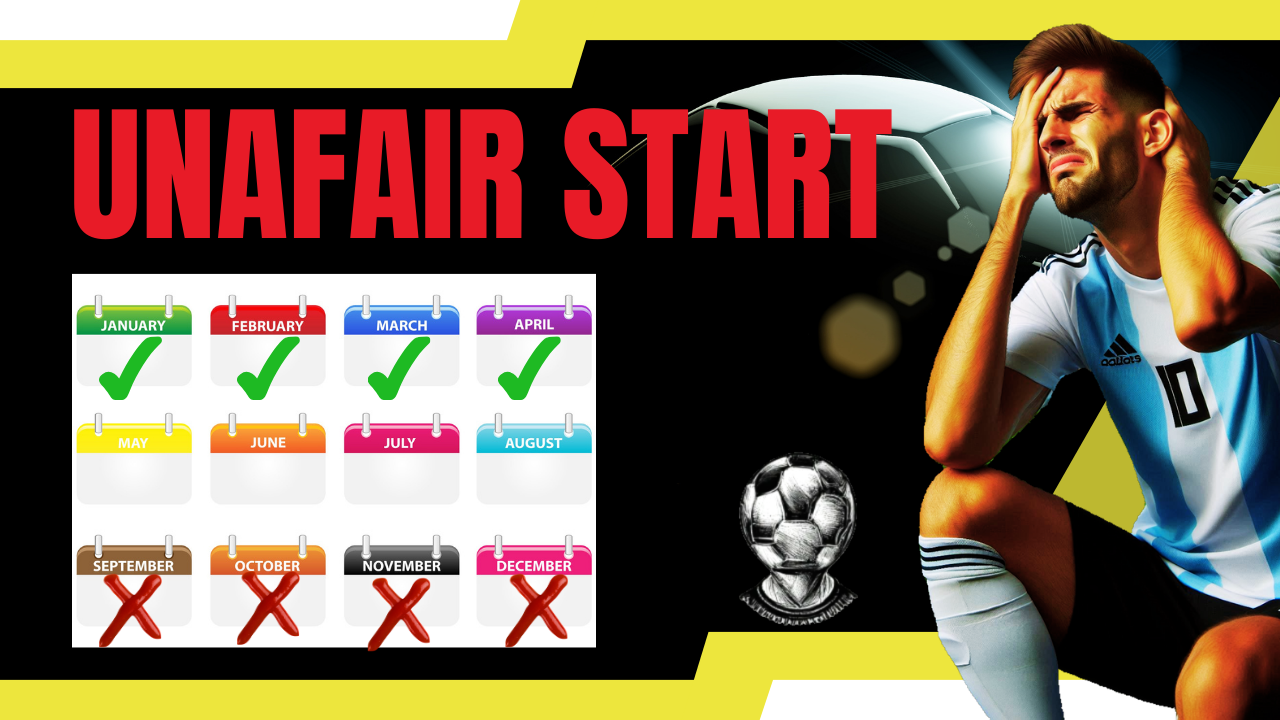
For example, imagine a U9 team where one player was born in January and another in December. On paper, they’re both “8 years old.” But in reality, the January player is almost a full year older, which is 10 % of the life of that kid, making them stronger, faster, and more coordinated. Coaches notice this, give that player more playing time, and invest more attention in them. The December player, meanwhile, struggles to keep up, gets fewer minutes, loses confidence, and sometimes drops out of the sport altogether.

This isn’t just theory, it’s been studied extensively. Malcolm Gladwell, in his book Outliers, talks about Canadian hockey. Most elite players were born in the first few months of the year because their age cutoff was January 1st. In the youth clubs and youth national teams, players play in teams based on their birth year. Those older kids were bigger, better, and therefore got selected for the top teams, which gave them even better training and competition. The small early advantage snowballed into a massive one.

Soccer works the exact same way. The date of birth can literally decide who gets the opportunities to grow and who gets left behind. The soccer federations usually try to fix this by reshuffling the months of the year – what if we make it by school year instead of calendar year? What if we mandate 3 players born in every quarter of the year to be invited for the youth national teams? Ok, maybe that last idea is not bad. But overall, the solutions often looks like they are putting a band aid on a broken leg. It looks like they are doing something, but only to somebody who has the TikTok attention span and understanding of the situation. The consequences and the issues are much deeper, so a little nothing change won’t go far.

Extra Problems Beyond Birth Month

Relative age doesn’t just stop at the calendar. There are other layers of inequality:

Late Puberty

Some kids hit their growth spurt at 12, others at 15. The early developers suddenly look like superstars, while the late bloomers might look like they don’t belong. Often, once those late bloomers catch up physically, they can be just as good—or better. However, if they don’t get the chance to play and to be coached by good coaches, then they won’t develop technically as much as the kids who hit puberty early. Not only they can be physically more dominant, but certain cognitive functions that influence their soccer positioning and decision-making, can also be affected.

Coordination During Growth Spurts

When players shoot up in height, their coordination often disappears for a year or two. It’s not that they’re unathletic—it’s just their body needs time to adjust. If coaches mistake that awkwardness for a lack of talent, they risk cutting players who just need time. I’ve had players who had completely lost their confidence because it looked like they got worse while other players got better. The reality was that their bodies grew so fast and everything looked clumsy for a while.

Late Starters in Soccer

Some kids only start playing seriously at 11, 12, or even later. At first, they might be behind technically, but many catch up quickly—especially if they bring in transferable skills from other sports like basketball, gymnastics, or track. Don’t forget that they will also look like they don’t know where to be on the field. Because they don’t. If they have been watching organized soccer for about three hours total, while others have been on the team for over three years, it’s like being confused why all people born in 1955 can’t play cello like Yo-Yo Ma. It’s not the birth year, it’s the decades of practice.  

At the youth level, physicality often outweighs skill. Being taller, faster, or stronger can dominate a game, even if the technically weaker player has better potential long-term. That’s why relative age, puberty timing, and physical development play such a huge role in who rises and who gets overlooked.

What to Do About the Relative Age Effect

So, all of this is bad? How do we fight back against relative age bias? Firstly, not everything is bad. Let’s look at the example of Mesut Ozil. He was technically and tactically as close to perfection as you can get. His vision and awareness were at the very top. However, even at his peak, he was physically inferior. He developed his skills while playing pickup with his older brothers and their friends. So he had to rely on non-physical advantages, such as the technique and vision. You might see the secret ingredient here. Firstly, he played a lot, and at a level that challenged him. Secondly, he felt safe and comfortable, because his brothers were there. Thirdly, he played both at the challenging level, with his brothers, and at the more appropriate level of physical demands. But when he played in his own club, he transferred the skills he obtained playing with the older kids. Lucky genius!

Advice for Coaches handling the Relative Age Effect

At the youngest ages, give equal playing time. Don’t bench kids just because they’re smaller or younger in the group. Development comes from minutes on the field. Your job is not to win with the 3rd team in the club with bunch of 10 years old kids. Your job is to give a chance for each of those kids to reach the 1st team in 5 years if they work hard for that.

Keep squads lean. If you have 20 players but only 11 can start, someone is losing valuable playing time. Keep the squad to 15 players and if you are short on few. Then loan players from other teams in the club. They should be able to play nearly every minute—it might not be good for “business” to keep the squad lean, but it’s the right thing for development.

Watch for late developers. Don’t write kids off too early. Some of the best pros were once considered “too small” or “too slow” at youth level. Develop the technique, decision making, communication and awareness. As a friend of mine, who is a basketball coach says “I can’t coach height, but I can coach everything else”.

Remember they are young players – they will discover their egos, face fears, social pressure and other challenges, many for the first time. As a coach, you are as much of a life coach as you are a soccer coach. The problem in front of you might not be to coach the technique of the trivela. Maybe is to make the kid believe that their teammates like them and will pass to them.

Advice for Parents and Players for handling the Relative Age Effect

Make sure your child is playing a lot. The most important factor is not what level they’re on, but how many minutes they get. I find it absolutely crazy when a parent would rather have their kid be on a bench of the 3rd team, than be a starter on the 4th team. Or even worse, sit on a bench during victory, instead of play the game in a defeat.

Don’t panic if your child isn’t on the top team right away. I’ve seen players jump multiple internal team levels within a single year—not because they were born in January or hit puberty early, but because they played nearly every minute and developed fast. Don’t forget that coaches are humans, so if the player is one of the stars on the team, they will get more attention from the coach, not just playing time.

Remember, soccer development is a long journey. A December-born player who sticks with it and gets minutes can absolutely catch up to, or even pass, the January-born kids. Your goals should always be to optimize for the love of the sport, which heavily influences the second most important factor, which is the development.

Final Thoughts


Relative age is real. It shapes careers, confidence, and opportunities in soccer. But if we as coaches, parents, and players focus on consistent playing time and patient development, we can level the playing field.

So next time you’re watching a youth game, don’t just look at who’s the biggest or fastest. Think about who’s getting the minutes, who’s being overlooked, and how much potential might still be hidden.

La Pausa - Art of Holding the Ball for Magical Move
La Pausa – The Genius Move to Stop Time

Imagine you can pause or even slow time. For 90 minutes, the mind is racing, the heart is pounding. The opponents are pressuring you, your coach and your teammates are always asking for more, faster and stronger. You can’t hear anything from the yelling on the sidelines and you are scared to make a mistake. Then you see a player that looks like they have all the time in the world. They take their time to pick the right pass, do the right trick, take the simple, easy shot on goal. They create La Pausa. How do they do that?

Speed is everything in soccer. But not always the kind you think. Sometimes, the smartest move… is to pause. “La Pausa” — the art of holding the ball just long enough to let your teammates move into smarter positions, to invite pressure, and to open up space that didn’t exist a second ago. Let’s break it down from individual, team and defending point of views.

What is La Pausa?

“La Pausa” is a Spanish term that translates to “the pause.” But in soccer, it’s not about hesitating—it’s about controlling the tempo of the game. Traditionally, it describes a moment where a player intentionally delays the next action—whether it’s a pass, a dribble, or a shot—not because they’re unsure, but because they’re waiting for something better to happen.

A simple example: A midfielder receives the ball from the back and could pass again right away—but instead, they hold for a second. That pause gives time for an attacker to make a more dangerous run, or for a defender to step out of position, or a winger to cut in. This moment of stillness creates disorder for the opposition and opportunity for your team.

Making sure we are clear – a situation like this is not an opportunity for la pausa. At least not a smart one. If the midfielder has an opportunity for a clean pass to the winger to play 1v1 to the goal, that should be executed immediately. The entire team is working to get a 1v1 or 2v2 situation close to the opponent’s goal. So if the midfielder holds the ball for too long instead of passing, then it’s a lost opportunity, not la pausa.

Now, soccer stars like Juan Román Riquelme, Andrés Iniesta, and Sergio Busquets made careers out of this skill. They didn’t just play the ball—they made defenders make decisions first. As you might guess, two key factors are the technical abilities of these players and the awareness or scanning. However, there is also one more key component and that is the trust of their teammates. Teammates need to make runs when they know that there is a little chance at the moment to receive the ball. The player with the ball often looks like they are not aware of their teammate making a run. However, the belief that the player with the ball can find the right pass is key.

Attributes of La Pausa Masters

Let’s look at the three aspects of la pausa. Firstly, the individual with the ball must be able to hold onto the ball. That’s why I try to minimize the one-touch rule in my drills. Instead, every drill is a one touch if the context is right, but it’s as many touches as it’s needed if the situation asks for it.

To improve the ability to hold onto the ball, I like to play king of the pitch, where everybody starts with a ball in a size of about the penalty area. Once a ball goes out, it’s out of play. All players without a ball tries to get a ball from somebody else and tries to keep that ball, so they stay with the last ball in play. This can be fun and useful for 5 years old kids, 15 year old teenagers and even 35 years old adults.

The second aspect is to have awareness, and to think before you receive the ball. It’s hard to make a smart decision if you start looking around you once you have the ball. You need to control, dribble and protect the ball, so if this is the first time you start looking for teammates and opponents, then start thinking what your options are, it’s probably too late. Imagine if there is a fullback making a run from deep, but you will need to pass to them in few seconds, not now. Do you think you will be able to see them and make that pass once your defender is onto you and your first touch have not set you up to do that pass? I don’t think so.

For coaches, if you want to design a drill, set a 5v5 in space where you cannot pass back to the same person. However, a way more important than anything, I tell my players to go and play pickup with the only objective of making sure that they can see all the players all the time. I don’t care if you are attacking or defending. Keep rotating your head to see all the players all the time. It should become like breathing to you. Your positioning and decision making will improve dramatically and everything else will become easier in the game.

The third aspect is about inviting pressure to yourself. Sometimes, your teammates have not moved and have not created an opportunity for that killer pass. The opponents have also dropped deep and are kind of still. At this point you did what you wanted, which is to take your time and freeze the game. The moment you move forward and dribble, it’s a cue for your teammates. They will need to move at the same time, creating opportunities all at the same time. You will drag defenders on you, but our teammates will also create chaos.

My favorite drill setup is of 6v4 plus GK. The numerical advantage will naturally create the defensive side to be a little more compact and less pressing. The three central midfielders will need to slow the game down and create the La Pausa. And at one point, switch the dynamics and get into an aggressive attack.

Is there La Pausa in Defense?

Ok then. We covered the La Pausa, but an astute soccer player like yourself might ask – what about in defense? What if I wait for the attacker to make the first move? Well, that’s called containing and is the most common thing in defending. Of course, you can press, especially in the opponent’s half. But containing is what we do in our own defensive third. We slow the game down and we wait for the attacker to make an error before we challenge them. So, no, we are not going to call La Pausa something that is so common. The reason why La Pausa has not spread is because it’s rare and it takes special talent and education to do well. Also, containing is taught in every club at every level. Coaches asking for players to get rid of the ball as soon as possible is yelled at even at recreational level when they are 5 years old. So, no wonder you can’t see La Pausa often – the players have been educated specifically not to do that. Enough ranting there. It felt good to get it off my chest, but also bad for the state of player development.

How to create La Pausa as a Team?

Let’s talk about creating La Pausa as a team. We kept talking about individual brilliance. Can we create this as a team? Yes, of course. I will give two very common examples. We talked extensively about breaking lines in another video on the channel. Say we are trying to break a high press. If a defender passes to the striker, who makes an easy drop to a midfielder, usually they have lots of time on the ball. This is because the defending midfielders dropped back because of the danger of the striker with the ball. This is the moment, when most attacking midfielders will try to push immediately, thinking there is a momentum. However, often times the momentum is against them with most of the opponents sprinting back to their goal. Instead, they can wait an extra moment for them to start pushing up again with a press. La pausa in this case is done collectively – entire midfield and defensive lines are moving back and forward, and it is almost certain that somebody will make a mistake.

You might say – this is way too specific, but I get it. It’s about inviting pressure and betting that the opponents are impatient and not disciplined. Can we utilize this even further? Of course. There is an old saying that “we are old too soon, and wise too late”. Don’t forget that soccer at the highest level is played by players between 20 and 35 years old. And let’s not get into the youth players. They are reckless, follow instructions for few moments only, are constantly encouraged for running a lot, and also are often more arrogant than confident.

If they play low block as a team, they start getting anxiety within 20 to 30 seconds without the ball. The opponent is passing the defensive line and all of a sudden the striker or the winger start to chase the ball all the way to the goalkeeper. If we can drag few players out of position like that, make them tired, while the rest of the team is confused if they are still playing low block or high press, then we are miles ahead of the opposition. So, our team needs to take advantage of this. If we can create this La Pausa as a team where we pass in our backline lower and lower, until either a long ball or a counter-attacking opportunity opens up, then it’s almost unfair how easy it would become to create chances.

The core of the pausa is to maneuver time and space, which is often interchangeable in soccer. You get more time on the ball by having more space, by positioning where to receive the ball. You get more space by creating time, by good first touch control into free space, pass into space and long pass. The player who creates La Pausa needs to both find the right positioning and have control and awareness to execute it. Maybe it will look like they are passing short only to find the third-man making a run on the far side. So, to maneuver time and space, they need to be in the right place at the right time, and, very importantly, be able to execute things very fast. The importance of the technique cannot be understated.

Defending La Pausa

The last segment is about how to defend against it. Firstly, low block means low block – if you’ve agreed to low block defend, don’t get restless. Secondly, marking is more important than tackling in team defending and if you have left your player unmarked, then you or somebody else will have to do heroic tackling instead. Why make it complicated, when you can keep it simple.

Finally, when you hear people talking about players like Messi and how the teams defend against him, they often say that they just hope God would help them. Of course, it’s a funny answer, but really you cannot defend Messi everywhere on the field. Now he is a bit older, so you hope you can make him tired by pressing him all around the field. However, for prime Messi that is not an option. Instead, your team should effectively let him do whatever he wants for two thirds of the field. Let him dribble all day in his own penalty box. Don’t press him, it will not work. Don’t let him drag your defenders out of position with la pausa. That’s what he wants – drag a defender out of position, pass by him which drags two other defenders out of position and all of a sudden the defense looks like Swiss cheese.

Defending la pausa is both emotional and psychological challenge. So the next time you’re coaching or playing, remember: Speed kills, but timing is what creates space. “La Pausa” isn’t just about slowing down—it’s about shaping the game around you. It’s about being calm in chaos. And when done right, it makes the whole team smarter.