How to become a soccer scout? [Complete Guide 2026]

If you’re passionate about soccer and love to watch and analyze the game, then becoming a soccer scout could be the perfect career for you. Scouting has changed in every sport for sure, and soccer is not an exception. Scouts can go and see exciting matches around the world, but they can also see them on their TVs with the technologies today like Veo and Trace. With the right systems they can really speed up the process of player evaluation. However, you can still see scouts of the largest clubs living in places like Croatia or Rio de Janeiro, turning every stone to find the next soccer superstar. Let’s talk about how you can take the first steps to become a soccer scout, what you will need to get further, and what the game is all about.

Step-by-Step: How to Become a Pro Soccer Scout

USSF created Talent Identification Centers across the USA. They are free one-day events for boys and girls that are 13-15 years old. The goal is to identify the biggest talent for future soccer stars for the national teams. Obviously, the first step is to identify the talent for the youth national teams. Now, that seems great in theory, but it is minute compared to what the European best clubs are doing. Furthermore, think about it – if there is a 12-year-old player who might be able to play at the national level, do you really need to wait and go to one of the identification centers? It is more likely that scouts of Dortmund, RB Leipzig, and Arsenal have already watched footage of the player. Yes, scouts watch footage of the best U10 players. It truly is that competitive.

In terms of education, there is a Talent Scout License that the USSF created in 2019. It is 8-day course, split into two parts. It requires the candidate to already have a B coaching license and work in an organization that already does talent identification. For comparison, the FA has 5 levels of education for soccer scouts, the highest being for Technical Directors. The first one is free, and you should take the online course even if you don’t intend to become a soccer scout. 

The Ultimate Guide to Soccer Scouting

Now that you know what it takes to be a licensed scout, let us guide you through the steps of what it takes to be good at it.

1. You have to love soccer

Most of the games you see will not result in anything really meaningful. Warren Buffett said that when he was young he went through every single company in Moody’s to find what he wanted to buy. When asked how to handle a large number of companies in the manual, he said “Start with A”. You just have to like the process of looking at an infinite number of games and players.

2. Define Talent

The potential of a soccer player is in four sections – Technical/Tactical, Psychological, Physical, and Social. You must be able to identify and evaluate all four aspects to become a good scout. I was at a tryout once for another team in my club, looking at one player that was playing better than most of the players. As always, they were small-sided 5v5 games. Every 2-3 minutes, it will take the ball from their own goal, dribble through 3-4 opponents and score a goal. The rest of the time was walking far from the ball, kind of like what Messi was doing at the World Cup.

As a scout, I learned only some aspects – fantastic dribbler, but don’t know if the passing and receiving are good. Physically, very explosive, but maybe low stamina. That’s most of it. See the issue? You need to see the players in various settings, with high and low pressure, such as games vs practices. Or playing against both stronger and weaker opponents. The most important thing is to be true to the evaluation and be sure you know that there are gaps you need to fill.

3. Become a coach

There is a good reason that the USSF requires you to have coaching license B before you can take the scouting course. The B license means that you’ve been a coach for at least several years. Being a scout can define life paths for young people, in a positive or a negative way. So, you have to understand the day-to-day life of these players, not just the performance on game day. Ask any experienced coach about the importance of coachability, and they will have many stories of young players who never made it because they did not have the right mindset for practice and relationships with any of the coaches. Other times, the issue is the particular coach and that is a key point to see. Become a coach to get the experience you need to understand both the human and the player that you want to evaluate.

4. Have a system and document everything

So, you’ve seen Moneyball and believe you can be Brad Pitt in soccer. The story is about the role of data analysis in scouting to give an edge in sport business. Of course, nobody dreams of becoming Jonah Hill, even though he is the real scout in the movie. Going through thousands of hours of soccer footage can be fun, but deriving data from it might not be for everybody. Then you start learning soccer statistical terms, such as xGs, possession percentages, progressive passes, tackling stats, and so on. But how do you make any sense of this when you watch 10-year-olds? You can definitely use Veo or Trace to get not only the footage but these statistics. However, it is up to you to document and create an understanding of them.

There are platforms that will help you not get lost in the data and will get better at both evaluating players and figuring out what matters and what doesn’t. It creates player cards and keeps the data over months, so you can see which traits progress over time. Perhaps certain aspects of the games improve or degrade, but also you will see if they are easily measurable and see their importance.

As we talked about before, statistics will tell you the Technical and the Physical aspects, but the social and the psychological, it’s up to you to evaluate. Furthermore, if you document your evaluation when a player is 10 years old, it will help you reevaluate them at age 12. It will help you evaluate the player, but also the coach – you can see if the coach had a positive effect on them. Finally, it will help you become a better scout by looking truthfully at your evaluations from 2 years ago and see if you get it right.

5. Fish where the fish are

One of the best players that I have brought into one of my teams was a 10-year-old boy that never practiced before. The parents didn’t speak good English and were not wealthy at all. Therefore, they didn’t look for a club, knowing that they cannot afford it. However, the boy played pickup games with his dad and his dad’s friends several times a week – that’s how I noticed him. When he came in, he was ready to compete with anybody and is still developing very well. It took a lot of effort to bring him into the club, and of course that was with a full scholarship. So, get out there and be in places where you normally wouldn’t be. The only way to grow is to get out of your comfort zone. You will meet other scouts, coaches and even agents of young soccer players. It will be fun! 

Your Path to Becoming a Soccer Scouting Expert

Becoming a soccer scouting expert takes time, effort, and dedication. However, it’s a very fulfilling and exciting career path. To become an expert, you need to keep learning. Stay up-to-date with the latest trends and technologies, and seek feedback from your peers and mentors. Ideally, you specialize in a particular area. For example, youth development, international markets, or data analysis. Lastly, you need to build your reputation, credibility, and brand. Communicate with people by writing articles, giving talks, and networking with other experts in the field.

Becoming a soccer scout is not an easy journey, but it’s definitely worth the effort. By following the steps outlined in this guide, you can start your path toward becoming a pro soccer scout. Remember, it’s not just about watching soccer. It is about making a difference in players’ lives and contributing to the beautiful game. Good luck on your journey!
9v9 Soccer Formation [Complete Guide for Soccer Coaches 2026]

In the US, there is a transition time in grassroots soccer that we play the 9v9 soccer formation. It is in the U11 and U12 age groups. This sounds fairly similar to the 7v7, where there are two years to coach the new formation before moving to a more complicated one. However, the lessons you need to teach the players and the challenges are vastly different. Don’t forget that eventually, you need to move to 11v11 where we’ll start with a 4-3-3 formation, so the lessons will be building blocks for that stage.

As we always do, we focus on the players and what they need right now. Firstly, keep in mind that at this age some of them are getting into puberty, while others won’t for a few more years. Secondly, some players have likely been coached well in 4v4 and 7v7, while others have no idea what formations are. Before you start complaining, keep in mind that even at the highest level, some players get tactics better than others. If you want the same level of background knowledge among your pupils, think about coaching tennis or chess. We are working on tactical player development with a long-term mindset.

What is the best 9v9 soccer formation?

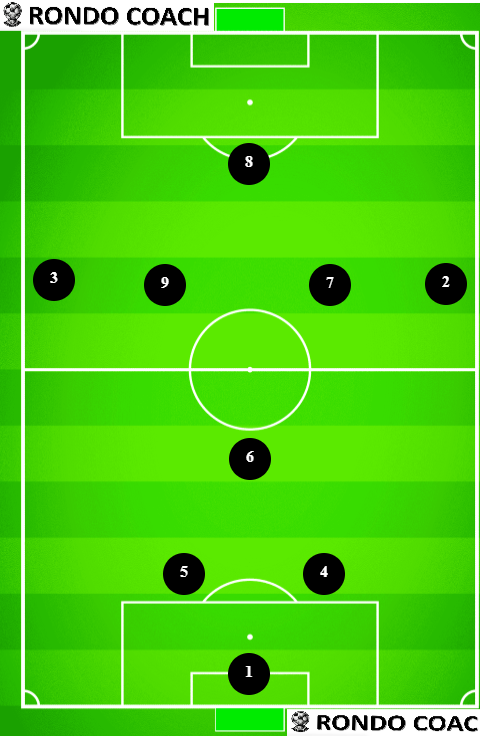
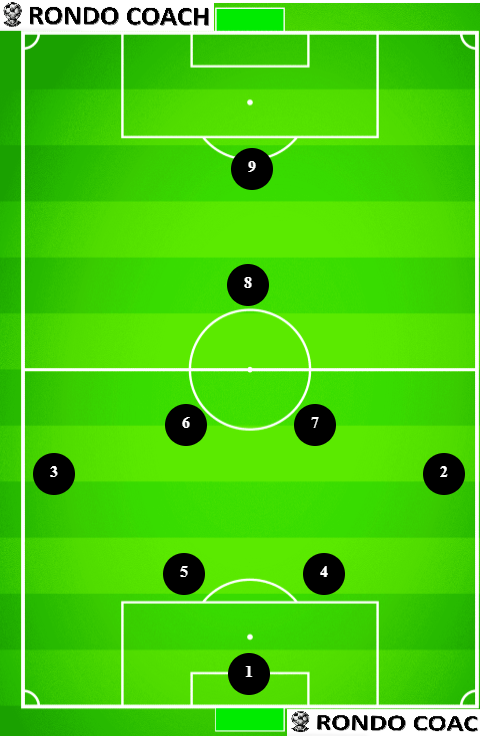
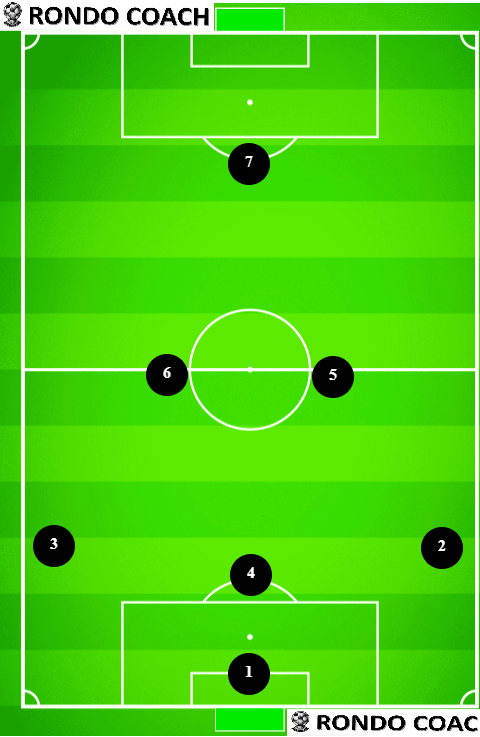
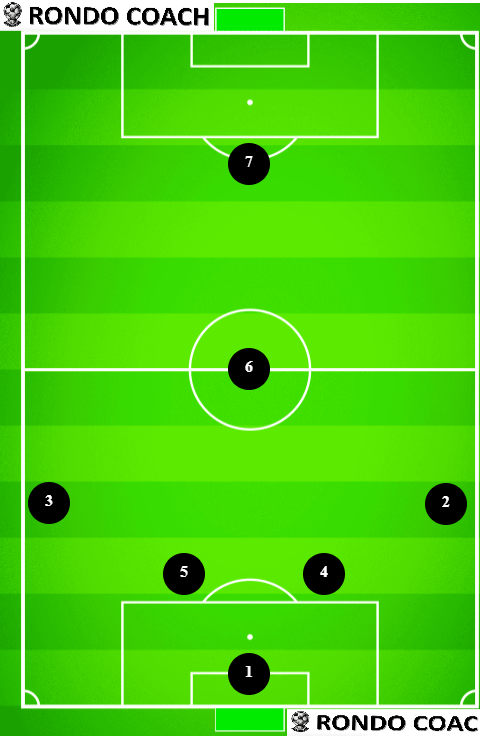
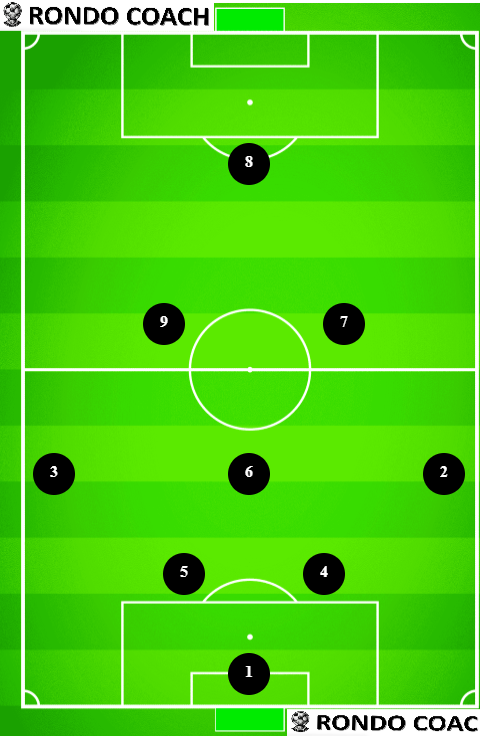
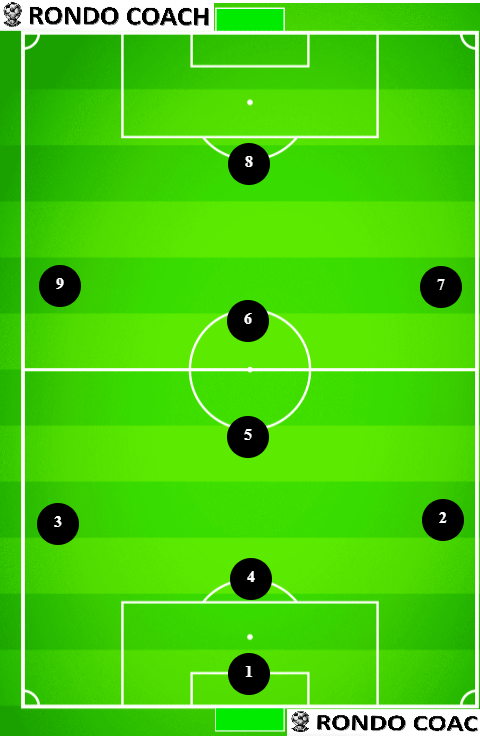
The best 9v9 soccer formation for youth player development is 2-3-2-1, or what many of the coaches call the Christmas tree. We said it in the 4v4 guide and in the 7v7 guide, this might not be the best formation for winning the game. However, this is the best formation to coach the tactical knowledge that the players need to learn at this age. You have two years of it and we do recommend coming up with a dual system where you start with 2-3-2-1 and later down the road progress to 3-1-3-1. We’ll walk you through the reasons, as well as touch on a few other options that can be used. 

Special note: you, as the coach, will start to feel considerable pressure to win. The players will hit that level of competitiveness because of puberty. The parents are becoming restless because they have read of the superstars being widely known at this age and their kids lose games. The coaches at the club wonder if you are doing a good job, while other clubs try to steal your best players. You will have to resist this temptation and have faith in the process. It’s a developmental process and it is a dance of the coach, the player, and the parents. For everyone’s sake, if somebody doesn’t like the music they will have to change it or leave the podium.

2-3-2-1

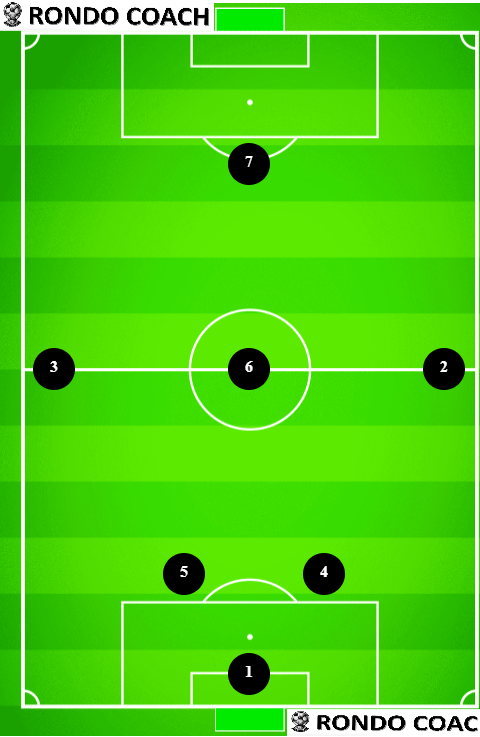
9v9 soccer formation 2-3-2-1 by Rondo Coach Formation Tool
Created by Rondo Coach Formation Tool

3-1-3-1

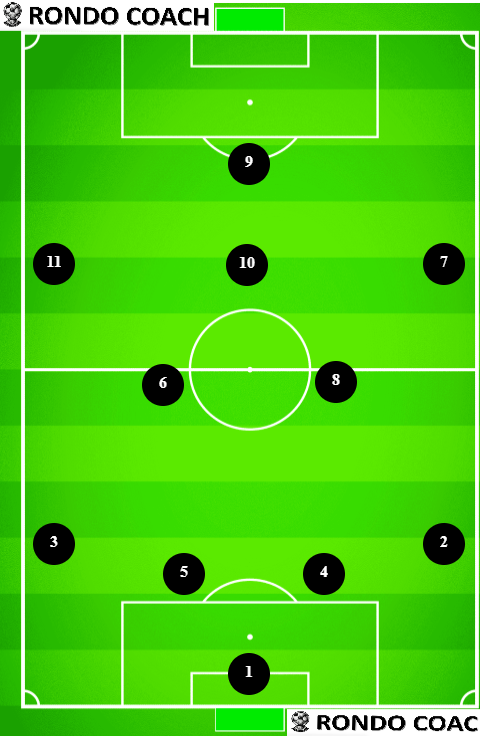
9v9 soccer formation 3-1-3-1 by Rondo Coach Formation Tool
Created by Rondo Coach Formation Tool

2-3-2-1 [Guide and Progression]

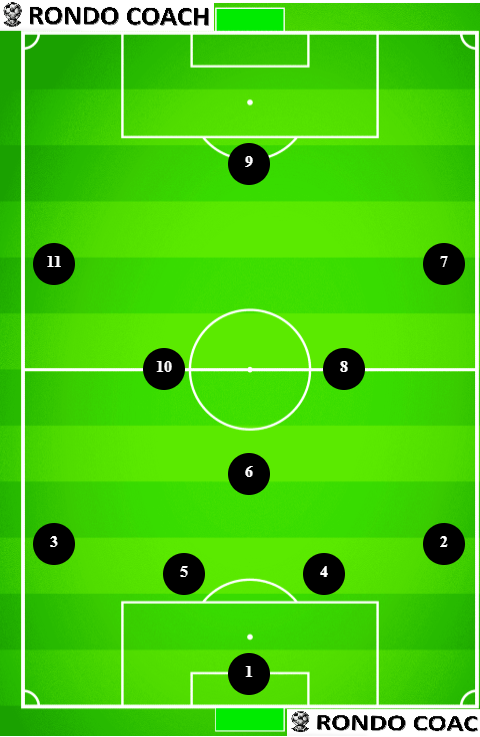
This is the formation that we recommend, as it has several benefits. From 7v7 and our favorite 2-3-1 formation, you add the 8 and the 10. The two central defenders already know well what their role is, as well as the wingers. Similarly, there is nothing completely new for the striker and the goalkeeper. However, the central midfielders become interesting now. 

Because of the hard work at 7v7, you have hopefully trained at least a main and a backup 6. The importance of the holding midfielder is that they are in two diamond soccer formation groups there – with the defenders and goalkeepers, and with the attacking players. Then the attacking midfielders have lots of freedom to act even as wingers and overlap and underlap with the wingbacks. Similarly, one time I had a team where the striker was so mobile that they acted as a winger to receive long balls on the ground and the attacking mid had open spaces. Other times they dropped to help out as a false nine. Truly an amazing partnership for that age.

PROS

Natural build-up from 7v7 and towards 11v11

Wingers are both defenders and attackers, so we develop them for 11v11 in a great way

The attacking midfielders get so much freedom and creativity, great for coaching new lessons 

CONS

Wingers have to be fast and disciplined

The skill of the two defenders has to be similar, otherwise will concede lots of goals

You need 3 dynamic and technical players in the middle, in addition to the dynamos on the wings

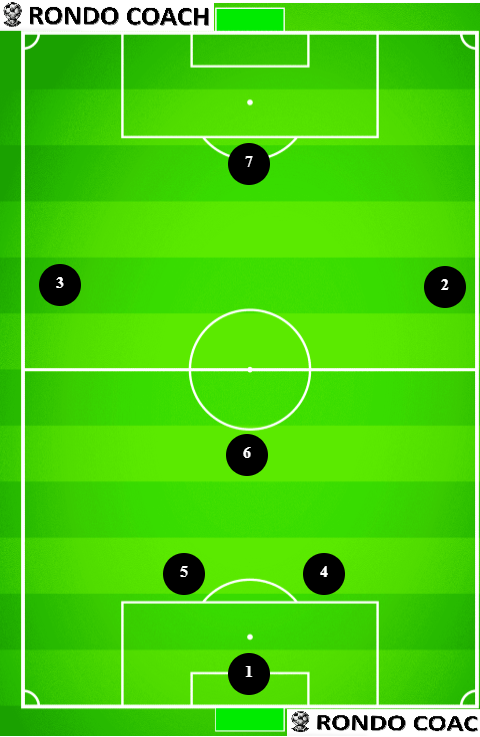
2-1-4-1 (attacking)

9v9 soccer formation 2-1-4-1 by Rondo Coach Formation Tool
Created by Rondo Coach Formation Tool

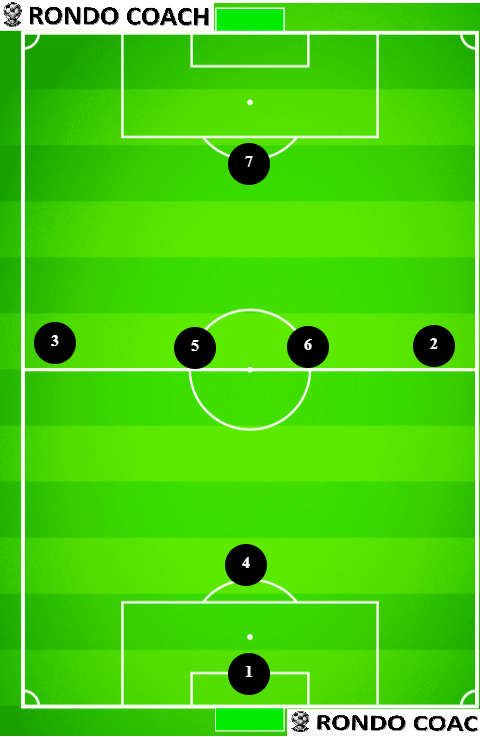
4-3-1 (defending)

3-1-3-1 [Guide and Progression]

The 3-1-3-1 is a popular formation and you should probably introduce it in the second year. It is a natural progression of the 3-2-1 formation we talked about in 7v7, with the addition of the two wingers. 

What we coach here is the width and the players will likely move less. When defending, the wingers and the wing-backs will be pulled in and have an overload. The biggest coaching point is to help them transition from attacking to defending quickly and to think about anticipation. 

You will likely not score much in this formation, but you also will rarely concede if you have a reliable central defender and an aggressive holding midfielder.

PROS

Development of a natural 10, which is the hardest position in attacking

We look more compact and solid in defense

Width is created naturally, with many players helping switch the ball from side to side

CONS

The goalie rarely plays with their feet

The wide defenders will attack less often

There is less opportunity for players to be creative except for the attacking midfielder

3-3-2 (narrow 3-1-3-1)

After you’ve coached the other formations, there is one thing that we have rarely coached and that is a partnership in the attack. Sometimes, you might want to play with two strikers, to show what it might look like. More likely, the reason why we want to play with two strikers is to pin down 3 or 4 defensive opposition players. If the opposition plays something like 3-1-3-1, then playing with two attackers can really keep all the back 3 and the holding mid back. 

We consider the 3-3-2 to be a variant or a progression of the 3-1-3-1. It is great for coaching the second striker role of overloading attack or midfielder.


Path forward for the 9v9 Soccer Formation

4v4 Formation by Rondo Coach Formation Tool
4v4
8v8 Soccer Formation 2-4-1
8v8
5v5
9v9 soccer formation 2-3-2-1 by Rondo Coach Formation Tool
9v9
6v6 Soccer Formation 2-1-2
6v6
10v10
7v7 soccer formation 2-3-1 by Rondo Coach Formation Tool
7v7
11v11

This is the full guide on how to coach the two years of 9v9 in youth soccer development. The ideas of roles and responsibility, team cohesion, solidarity, tactics, and strategy, are formed here at this age. It is important to have a system and to discuss it with the players collectively and individually. It will make you learn better approaches as a coach, but also it will make the players think about making a contribution to the team in whichever role they have at the moment. That mindset will set them up for success in every field in life. 

The guide explains how to use the 2 years of 9v9 to develop all positions that you might need for the 11v11 formations. Some soccer clubs mandate their youth level to play the same formation as the senior team. However, at 11v11, every formation is a fair game in our books. We will go deep into some of those formations and how to use them for teaching valuable lessons, which is the goal of youth soccer development.

How to become a soccer referee? [FULL Guide 2026]

If you’re passionate about soccer but need to manage the playing time and contact, it’s time to become a soccer referee. It is a great way to stay involved in the game, and if you never played then get involved. It is not only a great way to stay fit and active but also a great way to earn some extra cash. The reason why it pays well is that not everybody wants to become a soccer referee. In this article, we’ll guide you through the process of becoming a soccer referee. You should try it and if you love it at the end, just shoot us a thank you note!

College football referees discussing, Texas“/ CC0 1.0

Ready to Blow the Whistle?

First things first, before you can become a soccer referee, you need to make sure you have the right mindset for the job. As a referee, you need to be confident, assertive, and able to make quick decisions on the spot. You also need to be able to handle pressure and criticism from players and coaches, while still maintaining your authority on the field.

Did you read between the lines? People will yell at you when it’s not your fault!!! We’ve seen parents yelling at referees because their kid slipped on the ball instead of kicking it. An adult player screamed at a referee that he is “ruining soccer and the world”! Yes, they sometimes shake hands at the end, but the behavior can be surreal if you haven’t played much and don’t understand why people act that way. This is the main reason why people don’t want to be referees. However, if you think you can brush that off, keep reading!

Steps to Become a Soccer Referee

To become a soccer referee, you’ll need to complete a training course and obtain a certification from your local soccer association. The cost is about $99 but can vary sometimes – check USSF. The total time is about 6 hours to complete, half of which is in person. As we said, referees are treated almost like an endemic species. In addition to the payment for each game, many clubs cover the cost of the license (and future licenses) if you commit to their club. This means that you will ref a certain number of games, which is about 20 per year, for that club. To make it fair, that also means that you will not be the referee for games of that club.

Do you know the one requirement for becoming a soccer referee? Being 13 years old. That’s it! 

Game On: Refereeing Techniques

As a referee, your job is to ensure that the game is played fairly and safely. This means that you need to know the rules of the game inside and out. At the grassroots level, i.e. the youngest competitors, there are variations in the rules. For example, the size of the field, the number of players on the soccer field, and even some other rules vary. They sometimes play with a buildout line and no heading, for safety reasons.

I always bring both coaches before the game to go over these rules, as they often coach multiple teams and don’t remember them. At the lowest levels and with the youngest groups, some rules are made up on the spot. Foul throw-ins are ignored or I ask for a retake. To be a successful referee, you need to be able to read the game, anticipate plays, and stay focused on the action at all times. Remember you manage the players, coaches, and parents, and really you are managing their frustration. 

Winning in the World of Refs

Becoming a soccer referee is a great way to get involved in the game, stay fit and active, and earn some extra cash on the side. It’s also a great way to develop your leadership and decision-making skills. As you gain more experience and confidence as a referee, you can work your way up to higher-level games and earn more money. The levels of the referees are:

Grassroots – this is what we talked about so far. 6 hours of training, 13 years of age, and you are good to start.

Regional – it is a big step from the grassroots level. You need 3 years of referee experience, 50 games as a referee, 25 games as an assistant referee, and 18 years of age.

National – at this level the requirements get even more serious. You need 2 years as Regional Referee, with 40 games as a referee and 25 games as an assistant referee. From this level up, you are invited to take the course and cannot just apply for it.

We are not going through the upper levels of Emeritus, Pro, and FIFA. If you ever get into those categories, you should contact us for a profile interview. At that level, we are not talking about a small side gig, but a different level of commitment. So if you’re ready to blow the whistle and become a soccer referee, now is the time to take the first step and sign up for a training course.

4v4 soccer formation [Complete Guide for Soccer Coaches 2025]

In the US, the first time there is any structure and roles for the grassroots soccer players is when we play 4v4 soccer formation. It is in the U8 and younger age groups. So, before we jump into it, please remember that this is not about revealing secrets on how to win every game because of the tactical soccer genius that deserves folk songs. The score really doesn’t matter and it’s all about falling in love with the game and learning something new. This is the first time that players hear about a position, so just ease them in and ask them to think about it. The next transition is to 7v7 and they will have two years in that format. We are using these formations just as platforms for soccer development over the long term.

What is the best 4v4 soccer formation?

There is no one best formation for winning the game. However, mentioning positions is important for the players to start thinking about them. If you coach the team for a year, we recommend trying both basic formations and also rotating all the players through them. It will give you an idea of what their personalities are and how they might develop over time, especially as you move to develop the roles in a 7v7 structure. The two formations are 1-2-1, in somewhat of a diamond shape, which will be used throughout the soccer careers of these very young players; and 2-2, i.e. the square.

1-2-1 (Diamond)

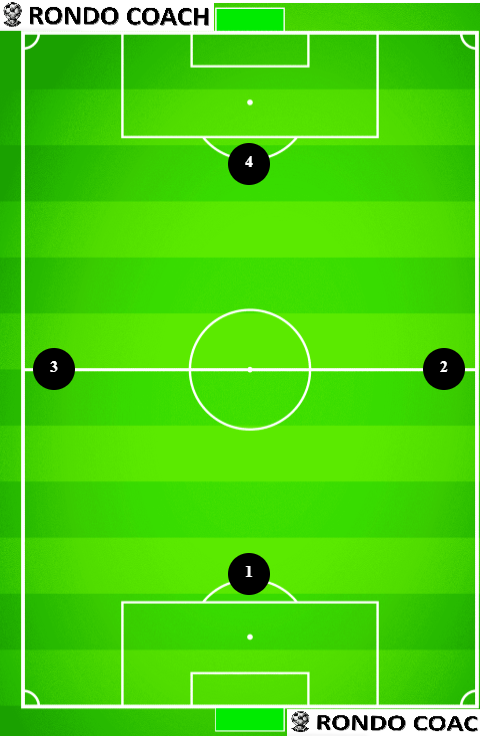
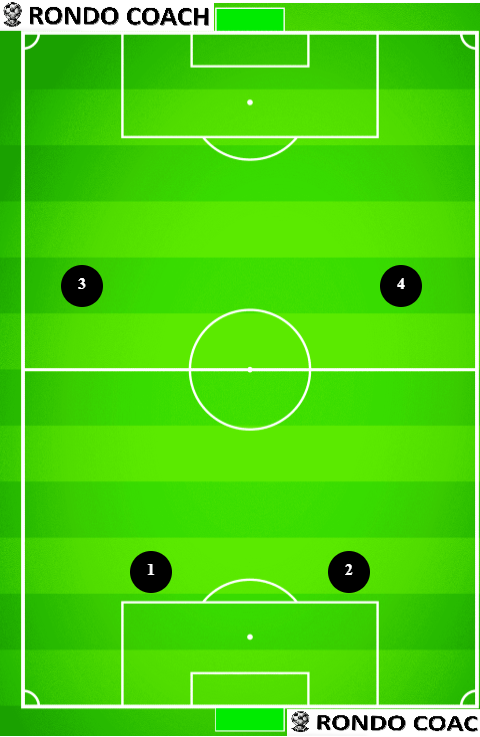
4v4 Formation by Rondo Coach Formation Tool
Created by Rondo Coach Formation Tool

2-2 (Square)

4v4 soccer formation 2-2 by Rondo Coach Formation Tool
Created by Rondo Coach Formation Tool

1-2-1 [Guide and Progression]

Start with this formation. Why? Because it is easier to teach. In a way, the players can have half of the field blocked. The striker can stay only in the top half, and the defender only in the bottom half. The left winger is only on the left half, and the right winger is only on the right half of the field. Those are the only instructions you need to tell them to get the ball moving.

This is the first time the players will start complaining or moving out of position. Make sure you rotate everybody in all positions. You don’t want players to feel like they will play in a position forever. However, demand that they try their best – “I don’t know how to defend” is not good even at that age. Ask guided questions about what the roles are in different positions as you keep coaching and you’ll get there before you know it.

PROS

Easy to start coaching

Great foundation work for the development of future roles, especially in 7v7

CONS

Too reliant on a single defender

The striker is the only one with true freedom of movement

2-2 [Guide and Progression]

Let’s say after 5-10 games the players understand the formation. Now, you decide to change it – what? Do not forget that if the previous formation is the first time that the players hear about formations. So, this is the first time they will experience changing it. We have changed formations on the fly when we play, but we don’t remember when we first heard about it.

The square formation is good because it teaches new things. First of all, it teaches cooperation – the two defenders have to cooperate. Secondly, it teaches the fluidity of movements. The two wingers sometimes can come to the middle and other times stay wide. Even one of the defenders can move up and act as a central mid, no issues there.

PROS

Players learn to communicate better

The two central defender formation is a great buildup for our 2-3-1 formation in 7v7

CONS

This formation is likely less effective, so players will be a bit more frustrated

Harder to coach, as there are a lot of nuances


The 4v4 soccer formation goal

4v4 Formation by Rondo Coach Formation Tool
4v4
8v8 Soccer Formation 2-4-1
8v8
5v5
9v9 soccer formation 2-3-2-1 by Rondo Coach Formation Tool
9v9
6v6 Soccer Formation 2-1-2
6v6
10v10
7v7 soccer formation 2-3-1 by Rondo Coach Formation Tool
7v7
11v11

This is the full guide on how to coach the tactics of 4v4 in youth soccer development. It might look short and it should be. The focus on tactics should be minimal at this U8 and younger age. You should focus on technical excellence in soccer development at this age. Of course, get the player to think about their roles and talk to them about it. However, keep it simple and honest, and make sure they are trying their best in every position they play.

7v7 soccer formation [Complete Guide for Soccer Coaches 2025]

7v7 is a very common and extremely useful format for soccer leagues, especially in the youth system. In the US, the U9 and U10 age groups, also known as the Development League, typically play in 7v7 formations. This structure is the first time that players start to really stick to a position, so it is important to understand them and coach the right lessons. This is the transition from 4v4, where formations are not really relevant. But the path forward is the 9v9, so that should be considered when choosing the formation. We are using formations for player development while having the long-term plan in mind.

What is the best 7v7 soccer formation?

The most widely popular 7v7 soccer formation is the 2-3-1. With balanced tactics that give opportunity to overload the midfield, stretch the field when attacking and allow for an extra defender to cover up for mistakes, this has been the best formation both for playing and for coaching. Maybe, there is no one best formation for winning the game. However, as you have two years of development at this age, we recommend doing the 2-3-1 for one year. This includes the 4-1-1 and 2-1-3 variations. Then in the second year, give 3-2-1 a shot to see if there is a natural central defender and to test the waters of playing with two central midfielders. That will help the transition to 9v9 where both 3-1-3-1 and 2-3-2-1 will be possible with the player development that you have.

2-3-1

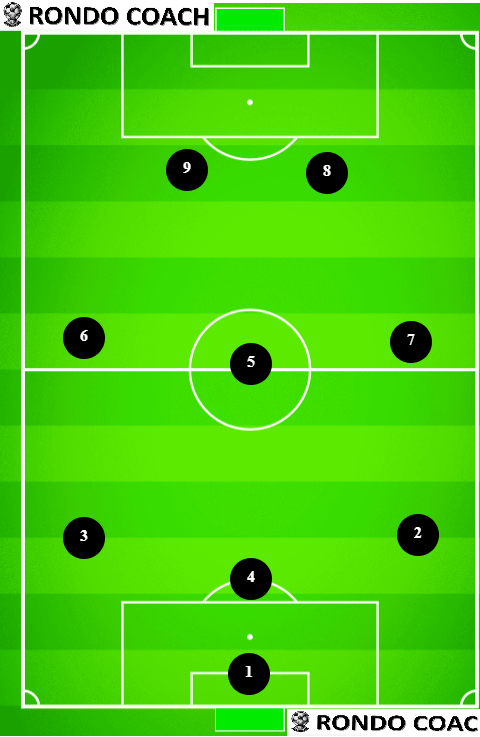
7v7 soccer formation 2-3-1 by Rondo Coach Formation Tool
Created by Rondo Coach Formation Tool

3-2-1

7v7 soccer formation 3-2-1 by Rondo Coach Formation Tool
Created by Rondo Coach Formation Tool

2-3-1 [Guide and Progression]

This is the formation that we recommend, as it has several benefits. Compared to 4v4, we have new positions in 4, 5, and 6.  The two central defenders are starting to build a partnership with each other, furthermore with the goalkeeper. The central mid is really starting to develop and the best player will be placed there. 

Start with this 7v7 soccer formation and let the players learn at least two different roles. The roles are defender, winger, central mid, and striker. Then try the variations of the formation to adjust to the players and the situation. There are two variations to this one – 4-1-1 and 2-1-3, depending on the role of the central midfielder.

PROS

Goalie plays with their feet and makes decisions, as there is no one defender in front of them

Wingers are both defenders and attackers, so we develop complete players

The central midfielder can be trained as both a defensive and attacking midfielder

CONS

Wingers have to be fast and disciplined

The skill of the two defenders have to be similar

The central midfielder takes lots of responsibility, therefore it is possible that nobody on the team can play that role proficiently

4-1-1 (defensive 2-3-1)

7v7 soccer formation 4-1-1 by Rondo Coach Formation Tool
Created by Rondo Coach Formation Tool

2-1-3 (attacking 2-3-1)

3-2-1 [Guide and Progression]

The 3-2-1 formation is the other logical choice and we recommend using that to supplement for what the 2-3-1 formation cannot teach. Remember, we are using these formations to coach, not just to win games.

There are multiple reasons why this formation can work well, but the biggest one is if there is a natural best defender and if there are two central midfielders that can split the duties and balance each other. If at 9v9 we use our favorite 2-3-2-1 formation, then the two attacking midfielders are the two attacking midfielders from here.

PROS

We develop two central midfielders that can work well together

The central defender is well-developed and likely develop a great communicator

The central midfielder takes lots of responsibility and it is possible that nobody on the team can play that role proficiently

CONS

Being a goalie can be very boring, as the defender took some of the responsibilities

More often than not all three defenders will stay back, so we’ll attack with only three players

The players in the middle will have much more of the ball and we will lack quality development of the team

1-4-1

This is the natural attacking formation of 3-2-1. Ideally, only one of the wingbacks will help on the attack, while the other one will shift to the defense. At this age, it is great to try and coach that. 

Unfortunately, this is what we have seen the formation looks like when U9 or U10 players are put in this structure. Therefore, it lacks natural variations of triangles and diamonds, and playing possession soccer is almost impossible. 


Conclusion

This is the full guide on how to coach the two years of 7v7 in youth soccer development. We focus on what skills our players need to develop through the games as experiences. Furthermore, we develop wingers and wingbacks that are fast and responsible. We develop defenders that can operate alone or in partnerships. Our goalies are good with their feet. The striker press the line high, while having freedom to go on the wings. Finally, we develop the central midfielders in both offensive and defensive duties. While our goal is to develop complete players, this is the complete guide on how to do that in 7v7 soccer formations, appropriate for the age. 

4v4 Formation by Rondo Coach Formation Tool
4v4
8v8 Soccer Formation 2-4-1
8v8
5v5
9v9 soccer formation 2-3-2-1 by Rondo Coach Formation Tool
9v9
6v6 Soccer Formation 2-1-2
6v6
10v10
7v7 soccer formation 2-3-1 by Rondo Coach Formation Tool
7v7
11v11

Why Technology in Soccer Development will be Revolutionary? [2025]

The Future of Soccer Development 2024

Technology is both exciting and scary. Perhaps not the use of technology in soccer development, but in almost everything else. We are bombarded by the horrible outcomes that AI will cause in this world. One side says that we will all be replaced and become jobless. Another side is saying that AI is already working against the human race and any day now it will win. We don’t know about AI, but we know soccer education and we’ll focus on exactly that. How do we develop soccer players? How can the technology help us do a better job at the moment? Where it will be in the next decade or two?

Which technology are we going to look at?

Before we jump into it, let us just define the technology we will analyze and which ones we will avoid. Computer technologies, including AI, machine learning, computer vision, AR/VR, data science, and wearables are all fair game in our analysis. As you can see it is all based on captured videos of soccer practices and games. We will not talk about sciences related to chemicals, drugs, or gene editing. It is a fascinating area of science and there is so much to explore. But we just don’t feel like experts in the area and don’t think we can add much color to it. If you are interested in learning more about gene editing our way to a superhuman without one word about soccer, we recommend most of the 500+ pages of The Code Breaker by Walter Isaacson. 

But what if we can use technology in soccer development to create the environment and achieve superhuman results through all the knowledge of psychology, child development, sociology, and technology that we have at the moment…

What are the challenges that soccer coaches face?

Let’s talk about what a technical soccer skill is – it is a motor skill, meaning the specific movement of the body’s muscles to perform a certain task. It is important to distinguish that there is no decision-making in this process, only the execution of a predetermined action. At the highest level of competition, the decision is conscious and the skill is subconscious. Colloquially, some people refer to it as muscle memory, and is present in all sports, playing instruments, body movements, and even writing. However, once we form our handwriting in our childhood, we do not change it in our life unless some serious injury occurs that forces our neural system to adjust. In the world of soccer, the legendary Arsenal manager of 22 years, famous for his talent identification, said:

…the base of the player is the technique. You get that between seven and fourteen years of age. If you have no technical skill at 14, you can forget it, you can never be a football player.

Arsene Wenger

Ironically, the most important on soccer development is actually not a soccer book. The Talent Code by Daniel Coyle explains what soccer skill is and how to develop it. The complete complexity of the myelin production neural pathways is too much to be fully explained even in that book, let alone this article. To simplify, the way to develop a skill is to strengthen the correct neural pathways that transmit the electrical impulse so that the muscles can behave to achieve optimal performance. Talent is the natural pathway, while “deep practice” is the best process of making the channels bigger and stronger.  

How do we do “deep practice”?

Let’s think about – how did we learn to write? We isolated only one letter, broke the task into pieces, and did each piece of it slowly with lots of attention and focus. We repeated that many times over and today we write the letter subconsciously. Now when we write a word or a sentence, we don’t think about the steps one by one. However, we decide on the words to use and the order in which to place them, and even the sentence that comes after that.

How does a piano player achieve the right tempo on technically difficult tasks? It is the same process of isolating the hard fragment and playing it correctly at a very slow speed. If that is too hard, we will split it into only the left and only the right hand separately. Then we will bring it together at a slow speed, before proceeding at a higher tempo. When the pianist moves to a higher speed, it is an adjustment or a correction and with the appropriate repetition, it strengthens the neural network even further.

The way we do deep practice is through precise repetition in a controlled environment. Let’s split those two interdependent terms. If the repetition is not precise, it will create a strengthening of the incorrect neural connections, resulting in a sloppy technique. Subsequently, that leads to creating an uncontrolled environment at the highest level of competition. On the other hand, if the environment is not controlled, it leads to an imprecise repetition and forming of the wrong muscle memory.

Why can’t coaches just teach “deep practice”?

Now that we know what the secret is, why can’t we just do it? Well, have you had an argument with a kid that they should practice their violin? If it is too easy then it’s boring. If it is too hard then it’s daunting. And this is a piece of music targeted specifically for the skill of this violinist. Now, try to target the right drill at the right level for your 15 soccer players at the same time. Impossible! What if there is a way to monitor the challenge to make it just right, at the right time for each player?

Flow

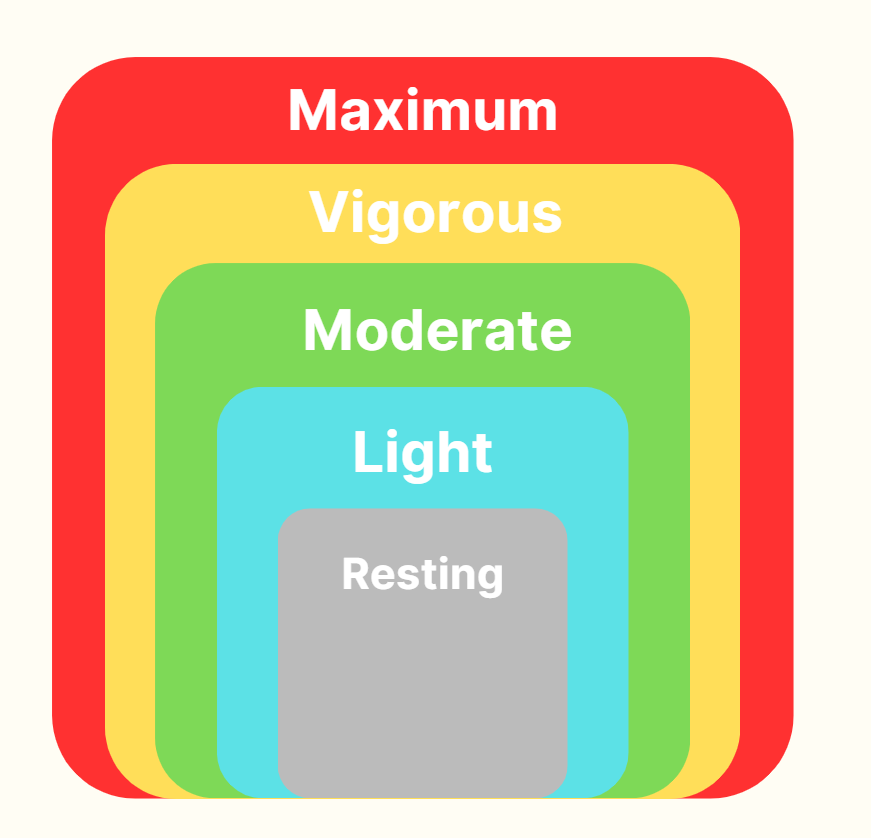
Let us make one more analogy with the 5 heart-rate zones and our soccer deep practice. We sit and lay down in the resting HR, so not really useful zone for our goal of deep practice. Light intensity is where we get sloppy because we lose focus and don’t have full control over our movements. Moderate intensity is where all our focus is on the precise movement, with no effort spent on decision-making or opposition. Vigorous intensity is when we have competition at practice to adjust and correct for a certain level of opposition, as designed by the drill. As we have said many times, we love rondos because we decide that level of intensity and opposition. Finally, the final red zone is for games and there is no technical development there because it is an uncontrolled environment as we discussed earlier.

Why is yellow the best level for strengthening neural connections? Because that is where the human is in their flow. We enter a hyperfocus state when the task is clearly defined, it is the right level of challenge, and we receive immediate feedback. The best creators of tools for the state of flow are video games, which is why there is always a desire to gamify learning.

What will be solved by technology in soccer development in the next decade?

Green zone

Let us reuse the musical instruments examples from before. The steps to improve a particular instrumentalist are to analyze the music played, identify the issue of that particular player, and suggest the exercise to be performed. Current tech can definitely do that and will likely not need more than a smartphone to do so. It will get better with AI and potentially image processing to suggest an adjustment of the hand posture and movements. It is definitely getting us closer to the flow.

Ball mastery apps

When it comes to technology in soccer development, we already have something similar in the market. There are products and apps that give a task (might or might not be appropriate for the player) and keep track of the quality of performance. Apps like Techne Futbol show the drill in slow motion that needs to be made and give a dose of dopamine when the user accomplishes a certain time of practice. A step further is DribbleUp. They show drills for ball manipulation and ball mastery and use a phone camera to measure the success rate of it. The flow is there with a clear goal and instant feedback.

A beginner coach can watch a Youtube video and repeat the movement slowly and in steps. The coach can have a stopwatch and count the movement of one player at a time. However, only an expert coach with years of experience can identify the issue in the motor skill and quickly find a way to correct it. I believe that the technology of image processing and machine learning is smart enough to do that. It should be able to detect issues in the movement – too little hip opening, too much knee bending, or arms too static…

With the amount of soccer data and soccer drills available, it should give feedback and pick the appropriate corrective drill to fix that. Then once that is fixed it will move to the next drill for that player. I have no doubt that by the end of the decade, an app will be able to do all that.

Yellow zone

Smart soccer training gyms

When looking at state-of-the-art facilities at La Masia, we can see that there are small turf indoor fields for individual player development. Using multiple machines to throw and receive, a ball comes from one place to the middle where a player receives it and passes to another place where the system indicates that the ball should go with a visual signal. The system is predetermined and the variations are randomizing the locations and the speed of the ball.

However, it seems like there is very little feedback that the system does to analyze the weaknesses of the player in the middle and target those. Adding AI to the system will bring the knowledge of the best coaches from the best academies in the world, practically to any gym that will have this system. A player can rent the tool and practice on their own the same way the best players in the world. Globalizing this tool will uplift soccer development in the world.

Devices

We talked about getting in the challenging zone with rondos, which makes us dominant in terms of numbers when we are in possession. However, it is up to the coach to design the right environment to dose the challenge just right. Now imagine using VR and AR devices we can always have the right amount of challenge. Imagine your teammates and opponents moving at the right place to vary the situation, so you make progress but are not overwhelmed. Wouldn’t that be amazing? We will be permanently in the correct zone for development and the situations will be designed to strengthen the exact neural connection that we want. That would be amazing and while it might take more than a decade or two to get to that point, we can see it happening at some point.

Why will the coach not be replaced by the technology in soccer development?

So, the soccer coach is done and we can finally stop coaching kids and just watch the World Cup? As if. The Talent Code talks about two other key components in the mastery of a skill – ignition and master coaching. I know from my cardio exercises that staying in the yellow zone is hard and it often requires a mental push. That ignition has to be sparked by the coach. However, master coaching requires silent observation and occasionally encourages good behavior and corrects bad one.

Have you ever noticed that a coach is good for a certain age group, but not for another? Being a youth soccer coach has three phases – animator, teacher, and competitor. That is according to the book that documented the path of soccer development in Croatia. For context, Croatia won 2nd and 3rd place in the last two World Cups. With a population of less than 4 million people, they had no business passing the group stage.

Soccer coach profiles

The animator role of a coach is for the youngest group of players, 10 years old and younger. At that age the ignition is not really there naturally and no technology will create it. Between the ages of 11 and 15, the profile of a coach-teacher comes to play. The players enter puberty and the coach needs to find the right balance within the team, providing not just guidance for the individual player, but also balancing the fire in the players and even between them. Finally, when the players are growing past U16, they compete and the coaches need to do the final push to get the best out of them at the right moment in every aspect – physically, mentally, and emotionally. 

These profiles will not change for the coaches with the current technology and the pathway that I can see. We are still so far from emotionally understanding, let alone connecting with the machines. Furthermore, the tech cannot help us relate to other humans in a genuine way. For example, it can help us identify who is Johnny and who is Jimmy. However, it cannot help us look genuine when we want to relate to the players. It cannot make Johnny and Jimmy like us or trust us, which is key to developing them as players and humans. Furthermore, it cannot determine that Johnny likes to compete extra today, while Jimmy looks like he is shying away from conflict. That is something that comes from life experience and emotional intelligence.

Summary

The importance of technology in soccer development has been talked about for decades. As the tech evolved over time and the amount of money poured into soccer, we are excited to see where we will get in the next decade. The future is bright and the role of the coach will change. Humans are the most adaptable species on the planet and I am sure we will adjust. However, it will be amazing to see how the technology in soccer development will create the opportunity for better technical coaching games everywhere on the planet, while the coaches can focus on adding even more value on top of it.

What are the roles in a youth soccer team?

Volunteerism is key in grassroots soccer development in the USA. We always see volunteer coaches trying their best to coach the players, then getting lost in other tasks and finally giving up. The coaches take roles they shouldn’t take and they start handling uniforms and field scheduling. Similarly to assigning players roles on the pitch, the team should assign roles in the operations segment.

To run a quality soccer team, it is vital to have the right setup in order not to burn out. In this article, we will explore the roles in a youth soccer team to improve your chances of success on the field. Sometimes the responsibilities overlap and can be handled by the same person, but if one person handles more than 2-3 responsibilities, it is likely that there they will eventually be overwhelmed and give up.

Coaching Team roles in a youth soccer team

Head Coach

Well, this is obvious. The head coach is responsible for developing and implementing training plans, managing the team on game day, and developing team tactics. They should have experience coaching youth soccer and be able to communicate effectively with everybody else. We write so much about soccer coaches, that we will likely not focus as much in this case. However, keep in mind that the head coach plays a role in each aspect of the team, including scouting and recruiting. Players will decide if they join or not based on the head coach and you can’t outsource that.

Assistant Coaches

Assistant coaches support the head coach and assist with training and game management. Ideally, they should have experience playing or coaching soccer and be passionate about working with young players. We have written about it extensively about the roles of assistant coaches and rightly so. Many new coaches try to work without assistant coaches because they want to make sure they bond with the team. However, not every coach is the right for the right players, so find a balance of different personalities and coaching approaches and it will work.

Goalkeeping Coach

The goalkeeping coach is responsible for developing the skills of the team’s goalkeepers. They should have experience coaching goalkeepers and be able to provide individualized coaching to help each player reach their full potential. This is the only specialized coach for a position, as we don’t really need seperate coaches for defense vs attack. Ideally, these would be additional practices, but if that is not possible, at least get about 20-30% of the practices assigned for dedicated GK practices for your goalkeepers only.

Conditioning Coach

The conditioning coach is responsible for developing the team’s fitness and stamina. They should have experience developing fitness plans for youth athletes and be able to work closely with the head coach to ensure that the team is in peak condition on game day. When the players are younger (U14 and younger) the role is more of a teacher. Some players don’t know how to run properly or have gone through a growth spurt recently. A competent PT or fitness coach can address that properly.

Director of Soccer / Coach Mentor

The director of soccer provides guidance and support to the coaching team. They should have experience coaching youth soccer and be able to offer advice and mentorship to help the team reach its full potential. Very often they are the best scout and recruiter for the club, as they have connections and the credentials to “sell” the club to players and parents. The goal is for the head coach to get unbiased opinions and feedback from somebody that doesn’t know the players but knows the environment, system, and the head coach.

Management team roles in a youth soccer team

Team Manager

The team manager is the counterpart of the head coach on the management team. They will communicate with the other people on the management team and on the coaching team. The team manager should be organized, detail-oriented, and able to communicate effectively with everybody. They are responsible for organizing logistics such as scheduling games, booking fields, and arranging transportation. Finally keeping track on any paperwork, such as registration of players and coaches, as well as any documentation or certification is a responsibility that is often missed and the team manager should handle it.

Parent Communication

Effective communication with parents is essential for a successful youth soccer team. A designated parent liaison should be appointed to keep parents informed about schedules, game results, and team news. Some parents have trouble with keeping up with the schedule, carpooling, uniforms, and gear. Most of the time, the players have nothing to do with that. However, if a talented player doesn’t make it on time or keeps missing something that their parents need to do, then having a dedicated person for it will make it easier for everybody. Furthermore, the player will want to stay on your team and no other team. We also like to share pictures and soccer stories of our players with the other parents to increase the team bond. 

Gear Manager

The gear manager is in charge of ordering and distributing team uniforms, equipment, and supplies. They should be organized and proactive, ensuring that the team has everything they need to perform at their best. This role usually has a spike at the beginning of the season when all players are getting their uniforms. However, there are activities to be done throughout the year when there should be special gear for the games (canopy, bench, field markers, game balls) or when the weather changes and new gear is needed.

Team Captain

This is the only player on the list, and we wrote about the captains extensively. We talked that the team captain changes once a year or more often. That is true for the other roles and it is important to have parents who are willing to pitch in. The captaincy is great to reward and to teach the player at young age. Also, as they get older, the captain will motivate other soccer players to practice harder, by being a role model.


By following these guidelines and structuring your youth soccer team effectively, you can improve your chances of success on the field and provide a positive and enjoyable experience for all involved. Remember, youth soccer is about more than just winning; it’s about building confidence, friendships, and a love of the game that can last a lifetime.

How to choose a captain of a youth soccer team?

Choosing a captain of a youth soccer team can be a daunting task. It’s not just a matter of standing out on the pitch with a captain’s armband. You need to find someone who can lead the team, make quick decisions on the field, and inspire your teammates to do their best. It is hard to do it at a professional level, but where do you even start at the grassroots? How do you know who is the right player for that? Let’s see the different roles of a captain at different ages, the traits to look for in a youth soccer captain, and how to make the final decision.

The Search for the Perfect Captain

What are the roles of the captain at different ages?

The role of the captain can vary based on the age of the team. For younger teams, the captain may serve as a motivator and role model for their peers. The captaincy also serves as an extra motivator for the player, not as much of a responsibility that usually the coach has. As the team gets older, the captain’s responsibilities may expand to include leading drills, organizing practices, and communicating with the coach. These are all roles that the coach and the assistant coach have when the players are at U10 or younger. However, to develop the players in the right way, the coach will start delegating small tasks to the captain.

Do I select a new one each season or each game?

There is no hard and fast rule about when to choose a new captain. Some coaches may choose a new captain each season, while others may select a captain for each game. It’s important to consider the team dynamic and choose a captain who can lead the team both on and off the field. At U10, I usually choose a captain for each game and often times there is even a vice-captain, to avoid any player being overwhelmed. Furthermore, it’s a great motivation tool for insecure soccer players. What I like to do at the U11 through U13 level is to choose a captain for the season. Keep in mind, there is a fall and spring seasons, as well as summer tournaments. So in a year, there might be 4-5 captains, which is good to balance the responsibility. From U14 and up, we choose a captain for the entire year.

Is this the first season the team has a captain?

If this is the first season the team has a captain, it’s important to discuss the role and expectations with the team. This will help ensure that everyone understands the captain’s role and can support their leadership. One reason why this is the first year with a captain is because they are U11 and this is the first time there is a captain for a longer period of time. In that case, I suggest limiting the initial responsibility, but adding over time. For example, the only instruction is to do a 5 min physical warmup before a game without the coach. Over time, there will be more requests, like setting up rondos or being in charge of making sure everybody has the right uniform. And it just keeps growing from there.

Guiding Traits of a Youth Soccer Captain

Commitment

One of the most important traits of a youth soccer captain is commitment. They should be dedicated to the team and willing to put in the effort to lead by example. Look for someone who attends all practices and games, and who is always willing to lend a helping hand. At the youth level you value commitment as the highest priority, and choosing the role model in the group of players is the key to success.

Extrovert vs introvert?

When it comes to personality traits, extroverts may seem like the obvious choice for a captain. They would tell jokes and stories on and off the soccer field. However, introverts can also be effective leaders. Look for someone who is confident and assertive, but who also listens to their teammates and values their input. Getting a good balance between the two is important. If somebody is an extrovert, but talks about other things than soccer, then it’s not a good fit. Similarly, if somebody trains well, but really doesn’t talk at all, it will not work. Striking some balance between the two is the right way to go.

Soccer skills

While soccer skills aren’t the key factor to consider, it’s important to choose a captain who is a skilled player. This will help them earn the respect of their teammates and make them a more effective leader on the field. Furthermore, you can’t have a player who sits on the bench and is not happy, because they can’t hold their spot on the team to be the captain. It is ok if the player is not getting playing time because of injury, but a lack of skills is not going to work. Sometimes coaches want to have players that play in the middle of the pitch, such as a box-to-box midfielder that can act as a carrilero or a holding midfielder, but it’s not that important.

Decision Time: Who Will Lead the Team?

Once you’ve considered all of the traits and responsibilities of a youth soccer captain, it’s time to make the final decision. Consider all of the candidates and choose someone who has the skills, commitment, and personality traits necessary to lead the team to success. Don’t forget that at younger ages the captain has a shorter time, so if you make a mistake, it is not a big deal. Also, as they get older, it is not a bad idea to let the team choose their captain. 

Building a Stronger Team Through Captains

Choosing the right captain can help build a stronger team dynamic and lead to greater success on the field. Encourage your captain to communicate with their teammates, lead by example, and inspire their teammates to do their best. With the right leadership, your youth soccer team can achieve great things on the field.


Choosing a captain for a youth soccer team may seem like a hard task, but with the right approach, you can find the perfect leader to guide your team to success. Remember to consider the different roles of the captain at different ages, look for important traits like commitment and soccer skills, and make the final decision based on what is best for the team. With a strong captain leading the way, your youth soccer team will be unstoppable.

How to choose youth soccer formation? [Guide for Coaches 2025]

Guide for Youth Soccer Formations

What youth soccer formation should I pick for my team?

Whenever I talk to a newer coach, they always ask me which youth soccer formation works the best to dominate and win games. The real question is which formations should I use at the youth level to develop the players that will dominate in their teen years. Each player needs to develop for multiple positions and roles on the soccer field, depending on their mindset. So let’s analyze the progression of the youth soccer formations with the assumption that we want to get to a 4-3-3 or 4-2-3-1 formation at 11v11.

Soccer formation for 4v4 (U8 and younger)

4v4 Formation by Rondo Coach Formation Tool
Created by Rondo Coach Formation Tool

There is really not much to choose in this case. The diamond shape, with no goalkeepers) will teach players what it means to play on the wings and what it means to play up or down the pitch. At this age (U8 and younger), that is all they need to learn. Each player should experience playing in each of the 4 positions.

Formation for 7v7 (U9 and U10)

7v7 soccer formation 2-3-1 by Rondo Coach Formation Tool
Created by Rondo Coach Formation Tool

This is the most common youth soccer formation for 7v7 and for a good reason. The new players here are 4, 5, and 6. Player 1 became a goalie, but this is when they need to understand that they are part of the team and that we attack with 7 players, including them. Players 4 and 5 start to build their partnership in defense and this is the ideal time to teach them to communicate and collaborate with each other, especially without the ball. Player 6 (defensive midfielder) is also the 8 (central midfielder) and 10 (attacking midfielder), and usually the best player – it is the hardest position to play and will make or break the team. Not everybody will experience playing at this position, but the several players that play there through the seasons should try to play in the different defensive and attacking roles.

Formation for 9v9 (U11 and U12)

9v9 soccer formation 2-3-2-1 by Rondo Coach Formation Tool
Created by Rondo Coach Formation Tool

Games are won and lost in the middle of the pitch. This is the age when specializing the midfielders makes sense without disturbing the squad. Adding two more attacking-minded midfielders and giving them the freedom to occupy the flanks when needed. The defenders learn how to shift sides because the field is getting wider and we introduce the overlaps at this point for the wingers.

This is the most controversial one and it is because parents and coaches start to care about results and not about development. The common youth soccer formation at this age is 3-1-3-1 which often leaves 1 or at most 2 attackers through the middle and it often translates to a defensive kick-and-run mentality. That might not be the biggest issue – the painful truth is that players develop less in this formation. The goalkeeper doesn’t play with their feet because the central defender does that role. The wide defenders don’t run up and down because they need to stay defensive and there is no space on the flanks. The wingers stick to the sides and the creative attacking midfielders cannot be creative because they need to stick to their position and be both 8 and 10.

Formation for 11v11 (U13 and up)

11v11 soccer formation 4-3-3 by Rondo Coach Formation Tool
Created by Rondo Coach Formation Tool

Everything comes together at 11v11, as you can see in the youth soccer formations video, and this is how we set our best soccer formation in a 4-3-3 shape, at least the first year of playing on the full field. The most common question I get is why we play with two central instead of two defensive midfielders. Firstly, we do this because it’s the natural progression of the 9v9. Secondly, we do this because #10 is the hardest position to play and there is no reason to pick somebody to carry that responsibility – if they do that already, they will naturally convert to it. The roles of the two central midfielders can be anything, from box-to-box midfielders to carrileros. Finally, until U14, the formation has nothing to do with finding the optimized way to win and it’s all about making a platform to develop players; if we forget that, we have missed the point of the entire exercise.

4v4 Formation by Rondo Coach Formation Tool
4v4
8v8 Soccer Formation 2-4-1
8v8
5v5
9v9 soccer formation 2-3-2-1 by Rondo Coach Formation Tool
9v9
6v6 Soccer Formation 2-1-2
6v6
10v10
7v7 soccer formation 2-3-1 by Rondo Coach Formation Tool
7v7
11v11
Soccer Coaches - Master and Apprentice

How to choose a soccer assistant coach?

Do I even need an assistant coach?

Yes, you do! Every famous coach was once a soccer assistant coach and had assistants themselves. It is not a coincidence. The only way to truly reward the soccer coach is to transfer all the knowledge you have. However, you should also learn from them, as much as you can.

First of all, you are a human. You need somebody to keep you in check and make sure your biases are not driving the wrong decisions. I know a coach that was so biased towards big players. His tryouts could have been performed without a ball, just by measuring the height and weight of the players. Another coach hated when players appeared lazy. He wanted to not offer a spot to his best striker, and made up so many reasons why that should happen – confirmation bias at its best.

Secondly, you are a true coach if you coach another coach. You truly believe in the work that you do. Then you want your philosophies, about soccer and life to spread everywhere. As painful as it is, you might have to do it one by one. Coaching a player is very different from coaching a coach. However, it’s equally satisfying to see how the mind meld happens right in front of you.

Thirdly, you don’t want to do this alone. It is way more fun to work together with other coaches and can really make everything better. I have had many assistant coaches and I have been an assistant on occasions, and I can say that I consider all of them friends.

Factors in choosing an assistant

1. Do you like the person?

As simple as it is, the question here is if you like each other as human beings in order to work together. Otherwise, seeing them at every practice and game will make everything less pleasant and it will make you a worse coach. If the secret to work happiness is to do what you like with people you like, you have to hold both of them true. Don’t overlook it as a factor, in fact, we’re keeping it at the top of the list.

2. Does our view of soccer overlap enough that we can work together?

If you cheer for two rival clubs, that is not a deal breaker. However, if you insist on coaching tiki-taka with rondos and the other coach insists on a kick-and-run style of soccer, that will not end well. You need to have the same idea of what you want to teach your players and how you want them to play. Then sit down together and be crystal clear about the language to use to communicate that with them. If you use the same keywords with your players, at practices and at games, that will amplify the message. However, if you use a different language, it will just frustrate them.

3. Does the soccer assistant coach complement me in any way?

I was at a game where the opposing coach had two assistant coaches. Whenever the left back would get the ball, all three of them will scream “Mark!”. Whenever their striker will get the ball, they will all yell “Cory!”. It is not only that their chants were useless and ignored by the players, but also there was no value in having assistants if they don’t offer something different. Soccer-wise, the assistant might be better at coaching technical skills while I coach tactical skills. On the other hand, I might be more serious while he keeps a good atmosphere. That balance is important both for the parents and the players.

4. Do you have similar goals for the team?

They don’t have to perfectly align, but they have to be roughly the same. I once had a head coach of a team in my club that just wanted the kids to have fun and wanted practices to be at least 50% of the time just games. His assistant coach was a father who thought that his 8-year-old son should win every game that season or stop playing soccer forever. You can guess – it didn’t work out well.

5. Can this coach be a head coach one day?

This question is important for two reasons. Firstly, you might need to transition to doing other things, such as taking over another team. Several times coaches have not planned for succession and that has often resulted in either overcommitting to leading more teams than a coach can handle, or leaving the team in chaos and losing the best players by the end of the year. Secondly, if the other coach has the ambition and the potential to be a head coach, you should work with them to achieve that. At some practices or friendly matches, you take the role of an assistant.

Also, start thinking about who should take the assistant coach role of the team one day. It is unlikely that the assistant will leave if they are a parent of a player on the team and just became an assistant coach to coach their kid.

Selecting the right soccer assistant coach requires careful consideration and evaluation. Do it right and you will have a forever mentor-mentee relationship.