
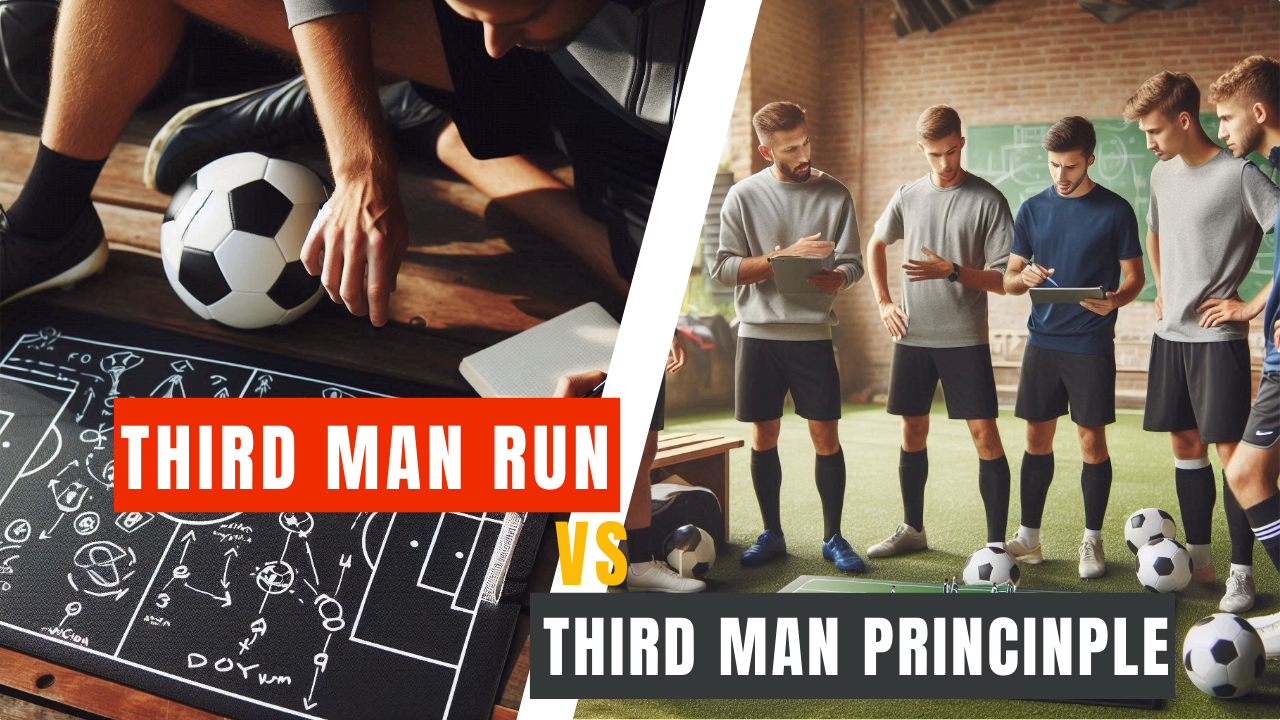
THIRD-MAN SOCCER

Third-Man: Tactics Every Soccer Player NEEDS to Know

The Third-Man Principle is all about creating passing options within the playing zone by adding a facilitating passer and exploiting space in ways that break down defensive structures. Third Man Run is about shifting the playing area. Move the ball into a place where the dynamics are more favorable for your team as there is a running player.

What is the Third-Man Principle?

The Third Man Principle is a tactical concept that revolves around creating an advantage by using one player to indirectly support another in possession. To put it simply, it’s about finding ways to create a passing triangles. One player makes a run to support a teammate, and the third player in the triangle (the “third man”) provides an unexpected passing option.

Basic Example

Let’s walk through an example. Imagine a scenario where Player A has the ball and is looking to pass to Player B who is in a good position to reach the team objective. Normally, the pass to Player B would be blocked by a defender. But Player C—who’s positioned just a little off to the side or behind—makes a run to receive the ball from Player A.

Player A doesn’t pass directly to Player B; instead, they pass to Player C, who then plays the ball to Player B. The key here is that Player C is not under pressure. The defender is left scrambling, trying to cover multiple options. This quick, unpredictable movement can create space and break down defensive lines.

Playing from the back example

Let’s give few situations of how the third man run can be utilized. Firstly, we’ll start with playing from the back. A simple pass from your goalkeeper to the central defender. Then you want the next one to be from your defender to your fullback, as it is a bit higher up the field and also safer and less crowded on the side. However, the opposition winger knows that and is blocking that pass and starting to put pressure on the defender. Instead, the central midfielder comes into the empty space and just needs to do a one touch pass to the fullback. That’s it. This is the bread and butter of playing from the back.

Final third example

Let’s look at another example, where the passing lane is not blocked, but the pass is impossible because the defender is pressing high. We want our winger to receive the ball from our fullback, but they cannot in this setting. Instead, we utilize the creative midfielder that does something similar as before, but in another area of the field. In this case, the moment the ball is passed to them, the defender is often stunned and trying to see where the ball is going or even starts to move towards the central area. The winger then starts to make a run and the defender is at least one step behind, often way off. The ball goes into space and the problem is solved way more elegantly than beating the defender 1v1.

What is the Third-Man Run?

The third man run is when two teammates look to be playing a one-two, but another teammate is making a run to receive the ball in a more dangerous area. In a very generic example, say we have a 2v2 situation in the central area. Then a player that makes a run in the wide area means that they have already won against their opponent and is just missing the ball. So we move the ball to them. Why would is it easier for them to beat their opponent? Because the human psychology makes their defender focus on the playing area. They either come and help the teammates to make a 2v3 situation, or they simply relax for a moment thinking that the danger is not there. Either way, it is a favorable situation for our third man. To get the timing it might be a one-touch pass or a delayed pass with La Pausa to invite the pressure and create space. We will run through three examples to illustrate this at different areas of the field.

Examples

If we start from the fullback and pass to the centerback. Then the winger keeps the pressing and cuts the passing lane back to the fullback. That press by the winger changes the playing area and takes our fullback out of it. Then the centerback passes to the midfielde. Now the midfielder passes into the fullback that made a run forward in the meantime. This pass made the playing area move there, with the fullback already on the run forward.

Here is another example of the third man run, way more devastating for the opponents. The focus is all in the middle with the striker looking for help from the midfielder to do 1-2 passing. The midfielder can even yell “1-2”, but then once it receives the ball, they find the runner on the wing. All eyes were in the central area. Unless the fullback was so diligent to track the runner on time, this can be an easy goal. The coordination between the winger and the creative midfielder falls apart.

Here is one more special case, where the striker wants to use the midfielder for a combination. However, after the pass and the run, the striker doesn’t get the ball and is in offside situation. Then the whole world kind of freezes. The defenders are thinking that they have solved the threat by holding the offside line. However, the pass to the third man in the wider area unfreezes the attack and the striker is back in action as the second pass can go to them.

What do you need to make good Third-Man?

The crucial elements of both the third man principle and the third man run are the off-the-ball movement, the vision and the exploiting of the space.

Off-the-ball movement

…is crucial. In the third man principle, the third man coming in as a facilitator needs to find the perfect timing when they will be available to receive and pass the ball. If they are too early, the opponent will adjust and potentially intercept the ball or the pass will not longer be available. If they are too late, then the teammate with the ball will be under too much pressure. Similarly, for the third man run, a well timed run is essential, so that we can create a dynamic advantage. Too early and the third man gets covered or ends up in offside. Too late and the ball is lost or moved somewhere else on the field.

Vision

… is the other key characteristic of these patterns. Vision is not about players that can see other players, but it is to see several steps ahead, like in chess. In the third man principle, the player needs to see the objective of the two initial players and their obstacle. Then they need to see how getting into the empty space can change the perspective. Finally, how the steps will evolve from then on. Similarly, the third man run is exactly that – a run. The vision of the passer and the runner is seconds ahead, where they need to see what will happen if they coordinate their movements together. The vision is built over time and experience, by playing soccer for years and years and seeing what is possible and how to make it happen. Naturally some players are more talented in seeing this, but it is also a trained skill.

Exploiting space

…is the secret to both the third man principle and third man run. We talked about changing the playing area by moving the ball. But in order for that to happen, the players off the ball need to create a favorable situation before the ball gets there. Exploiting the space is exactly that. For example, leaving the space empty is important, so that the space can be exploited at the right time. This can be the space for passing or for the run behind. Either way, understanding the space is vital.

Can you see the Third-Man in Pro Games?

One of the most iconic uses of the Third Man Principle is in the way Barcelona used it during their tiki-taka era, especially under Pep Guardiola. The movement of players like Xavi and Iniesta was a textbook example of the Third Man Principle. They were constantly working off each other’s passes and positioning, pulling defenders out of position, and creating extra options for the ball carrier. It would often look like they were passing to each other with no purpose. However, at one point you will see the wingers, such as Villa, Pedro or Henry, or even the wingbacks, like Alves and Alba, making a run on the wing and before you know it the third man run creates a perfect opportunity to score.

That is a textbook example of using both the third man principle and the third man run. However, I challenge you to watch a game. Whenever you see players playing from the back, you will see the third man principle. Also, you will see runs that hard-working players make even when they don’t get the ball. The expectation for them is that they will get the ball once every 5 to 10 runs. However, all they need is one perfect play in the final third and the goal scoring opportunity is there.

How to coach?

There is a reason we are still talking about the Xavi and Iniesta style of play, even though we haven’t seen them play in Barcelona for the last decade. It is not normal to find players that are technically dominant, have world class positional awareness and possess exceptional vision.

However, you do need to coach these concepts, as both Xavi and Iniesta have been coached at the famous Barcelona academy called La Masia. At the very young age, you should coach playing from the back and that might be the first time they will see the usage of the third man facilitator player. These will become recognizable patterns for the players, but it will take years of repetition and variations to become second nature.

You will need to have overloading drills, where the attackers will outnumber the defenders. This is because the natural moves for players might be to dribble or to pass back. Instead they can make overlapping runs or even underlapping runs that will naturally create the third man situation. If you are trying to change that, then the pressure has to be decreased a bit. Not completely, but sufficiently enough to give some time and direction to the players to find these opportunities. To counter this numerical overload, you can restrict the attackers not to be able to pass back to the same player.

Summary

To sum it up, the Third Man Principle and the Third Man Run are game-changing tactics that relies on intelligent off-the-ball movement, quick decision-making, and exploiting space. Whether you’re a player or coach, understanding and implementing this principle can improve the fluidity of your team’s attacking play and help break down defensive lines.

Next time you watch a game, pay close attention to how teams use the Third Man Principle and the Third Man Run to create space and opportunities. It’s a subtle, yet incredibly powerful aspect of modern soccer tactics.
woman playing soccer ball on grass

What is pickup soccer? The foundation of every soccer player

“Kids don’t play soccer on their own and we have to do something about it”. I’ve heard this from every coach I’ve talked to. Then they come up with “genius” marketing ideas to lure them with pizza instead of good protein snacks, but I digress here. While kids don’t play as much as they used to, it’s not completely true. I keep hearing from my players that they play pickup soccer at recess. Or that they play after school or in their backyard. Or they play for the school team. The value of unstructured play or mismatched competition is incredibly high. We will explore where to find these games, the benefits of playing and how to make most out of it. Regardless of the format (5v5, 6v6 or 10v10), the location (grass, turf or futsal) or even the game (soccer, skills challenge or soccer tennis), the value of playing soccer outside of the regular practices and games will develop the players in a different way.

“Edgar Davids wanted to play in the local neighborhood. I told him that we had training every day and that we couldn’t go and play with kids in the street. So he told me ‘You’ve changed! You don’t remember your neighborhood and what you did before.’

Once or twice, I went with him. But he did it often. It was impressive because we were having fun, but it was also crazy to go, after training , playing on the tarmac with the kids. He did it a lot and had great technique”

Zinedine Zidane, soccer legend, about Edgar Davids playing pickup soccer during their time in Juventus (1996-2001)

Where to find pickup soccer?

  1. Facebook Groups! I know that it sounds like I have not been online for the past decade, but there really are more pickup events on Facebook than any other place. Especially if you are a parent looking for games for your kid – where do you think other parents are active? Not Discord or SnapChat or TikTok, but Facebook. Alternatively, look for MeetUp events created by folks. Obviously many groups just communicate over WhatsApp, WeChat, Viber or even regular group text message chat. However, they are usually private and can’t just find them online.
  2. Individual practices at the nearby field. Get a ball and do some kicking at the goal. It is unlikely that anybody is going to kick you out, such as school custodian or something like that. However, if they come and ask you to leave, it is a prefect opportunity to start a conversation. “Sorry, I didn’t know it is not public. I’ve seen others play. Do you know when and where people play pickup games nearby?”
  3. Stop by around fields and parks. I often go for a run or a bike ride, and when I see a soccer field, I go close to check out if anybody is playing. Often times there is nobody there, but sometimes people play.
  4. Start your own! If you already have 3-4 friends that might want to play, create your own group. If you really want to get awareness, do the things above, such as creating a Facebook or MeetUp groups. The important thing is to get the contacts and keep them posted. Then, you might want to consider joining a league if the commitment is high and the quality of players is similar. If the group becomes large enough, you might need to think about renting a field and getting insurance. If the group becomes enormous, you can create a league on your own or at least a tournament. It can become a fantastic soccer side hustle.

Benefits of pickup soccer and unstructured soccer games

Sometimes parents ask me if their player has to come to practices in order to play in games. I often compare soccer to piano. If a piano recital is the game, soccer practice is the piano lesson, then piano practice are backyard and pickup games. You don’t go to the recital if you haven’t taken lessons. You often don’t do recitals if you have practiced on your own either. However, for some reason parents think that it’s ok to go only to the games and not to the previous steps. As coaches, we show drills and technique, correct mistakes and build platform for individual and team development. But it is up to the players to get repetitions until they get fluidity, instead of trying those movements for the first time with an opponent sprinting straight at them.

How to make most out of pickup soccer?

Pickup games can be great, but they can be annoying. Sometimes people want to take it too seriously or to goof off. Players often play dangerously or don’t try at all. Finally, the difference in skill levels can make it a bad experience. However, there are some ways to make the most out of it, even in these situations.

  1. Play against worse players than you. You have to practice controlling the ball and play possession with purpose and intensity. If the opponent is faster, stronger and better than you, then you will likely try to get rid of the ball whenever you can.
  2. Play against better players than you. If you play against better player, they will attack your weaker spots. You want that to happen at pickup games and on at championship finals! So, position yourself to be there and lose the ball multiple times, until you get the movements perfect.
  3. Pick an uncommon position for you. If you usually play as a left back, try playing as an attacking midfielder. The position will force you to learn new things, such as do more scanning or pass with one-touch passes.
  4. Try unconventional things. I am talking about trying crosses or through passes, or other things that you usually don’t do. It is at pickup games that I learned many of the moves I do now at regular games, such as the la croqueta.
  5. Play in bad weather and weird terrain. When the weather gets bad, like rainy soccer season or the soccer pitch covered in snow, many people stop playing pickup soccer. But the pros are still playing and they get used to it. If you want to get used to playing through rough weather, including heat waves, you have to at least play low intensity pickup.
  6. Don’t be afraid to lose the ball. Yes, there are some folks that keep on screaming at their teammates during pickup games like their life depends on it. However, just brush it off and be ok with losing the ball. The only way to grow is to play with some risk in terms of the result.
  7. Stay safe! The most annoying thing is to get injured during a pickup game because of some reckless challenge. Silly thing like that can make you miss soccer for weeks and more. There was one time I saw a player doing rough challenges at a pickup game. He kept doing it even though some of his friends told him to stop. I just moved across the pitch to play in an area as far away as I could. Eventually I stopped coming to those pickup games because it was too risky for me.

How much unstructured soccer is played?

“Just 27% of children said they regularly play outside their homes, compared to 71% of the baby boomer generation.” While nobody is particularly surprised to see the difference for soccer kids in the USA, it is really important to think about the consequences. Playing outside will bring some challenges that the kids will need to learn to handle. I am talking about social challenges of not getting a field or a ball, or enough players, or older kids taking over the game… So many issues can arise that the players will learn from. However, I focused on the soccer skills that will be gained by playing pickup games, as well as how to make the most out of it. I keep playing today, well past my prime soccer days. I love it and I hope you will, too. Happy soccer!

four women embracing each other while smiling

The Decline of USWNT Dominance at Women’s World Cup 2023

Since its inception, the Women’s World Cup has been a stage where the world’s finest female football talents converge to compete for glory and showcase their skills on the global stage. The United States Women’s National Soccer Team (USWNT) has enjoyed an unprecedented era of dominance. They won 4 out of the 8 World Cups so far, placing in the top 3 on all of them. The biggest US soccer superstars ever have achieved their heights with the USWNT. However, the 2023 Women’s World Cup has marked a significant shift in the landscape. The team faced an unexpected exit in the early knockout phase. People are shocked and the US public is disappointed. Let us look into the evolution of the Women’s World Cup to understand the reason for the decline in USWNT’s dominance.

A Glance Back in Time: The Evolution of the Women’s World Cup

The Women’s World Cup, first introduced in 1991, marked a pivotal moment for women’s football. The inaugural tournament, held in China, opened a window to a previously unexplored arena for female athlete. The rise of women’s soccer worldwide is undeniable. Over the years, the tournament gained momentum, attracting growing interest and showcasing exceptional skills and determination.

Throughout the tournament’s history, the USWNT emerged as a powerhouse, securing four titles – 1991, 1999, 2015, and 2019. Their triumphs not only highlighted their dominance but also played a crucial role in elevating the popularity of women’s football worldwide. The team’s relentless pursuit of excellence made them a source of inspiration for aspiring female athletes everywhere.

Sport dominance is not normal

Nobody in soccer has had as much success, closest being Brazil National Team between 1958 and 1970, winning 3 out of the 4 titles. Basically, that is a statistical anomaly, not just in soccer, but overall. During that time, every kid played soccer for endless hours on the streets of Brazil. That team had one of the best players of all time, and definitely the best player of his time – Pele. Unlike today, the players of the team were mostly playing in the national league in Brazil and could time their form for the World Cup. While that was a hard period for the country, the national team was a unifying opportunity for the nation. It is impossible to imagine such dominance in today’s world of soccer. The clubs have so much money that it always take precedence over the national teams.

For people outside of soccer, the USWNT looked like the US Dream Team with Michael Jordan, Magic Johnson and Larry Bird in it. In fact, it is with great confidence we can say that the US had 12, if not 14, of the 15 best basketball players in that era. Let us be honest, even in the best years that couldn’t be said for the USWNT. So, while the dominance is clear, we shouldn’t overplay it. We will likely refer to the titles in 2015 and 2019 as the “golden generation”. Furthermore, it is important to understand that it is not normal to have that kind of talent when the competition is the most popular sport in the world. If the activity is underwater chess or pickle eating, that might have limited competition, but not soccer.

The Shifting Landscape: Why USWNT’s Early Exit is Not Entirely Surprising

Something has changed and let us take a look at it. While the USWNT’s history of success is undeniable, it is essential to acknowledge that the global women’s football landscape has evolved dramatically since their first triumph. Over the past few decades, investment, development, and increased support for women’s football have led to significant improvements in team dynamics, tactics, and overall competitiveness. Several factors contribute to the decline in USWNT’s dominance:

  1. Rise of Competing Powerhouses: Countries like Germany, France, and England have invested heavily in women’s football. They have talented squads capable of challenging the USWNT’s supremacy. These teams have honed their skills and developed tactical strategies that enable them to contend at the highest level. The best soccer clubs in Europe are competing in the UEFA Champions League with their women’s teams and they want to win. So, they leverage their fanbase, finances, scouting and coaching systems, as well as medical teams, infrastructure and knowledge.
  2. Development of Youth Programs: The success of the USWNT inspired countries to invest in robust youth development programs. As a result, younger soccer players have gained access to higher levels of coaching, facilities, and competitive opportunities, accelerating their growth and contributing to the overall elevation of the sport. In fact, the USWNT has supported growth of women’s soccer in countries like China, Japan and Jamaica. Not surprisingly, their women’s teams are ranking higher than the men’s national teams.
  3. Globalization of Women’s Football: The expansion of international talent pools has diversified the competitive landscape. Players from different continents now compete in top leagues around the world, sharing their experiences and learning from one another. This cross-pollination of talent has fostered a deeper understanding of the game and led to increased tactical innovation.
  4. Strategic Adaptation: Teams that once struggled against the USWNT have evolved their strategies to neutralize their strengths and exploit their vulnerabilities. This has led to more evenly matched contests, challenging the USWNT’s dominance and raising the overall level of competition. As any other national team, there are highs and lows when it comes to talent. Without dominant attacking superstars, it is obvious that it is hard to score goals even if the team dominates in other aspects of the game.

The Natural Progression: Other Teams Catching Up

The USWNT’s early exit from the 2023 Women’s World Cup should not be perceived solely as a decline in their abilities. Rather, it serves as a testament to the sport’s global growth and the natural progression of teams worldwide. The rise of other competitive squads is a testament to the effectiveness of investments, dedication, and long-term planning put forth by various nations.

As other teams have caught up, the overall quality of the Women’s World Cup has significantly improved. The unpredictability of matches, the emergence of new stars, and the increasing competitiveness have led to a more engaging and captivating tournament. It’s better for the fans, for the players and for the rising popularity of the sport.

Path forward for the USWNT

The 2023 Women’s World Cup has marked a turning point in the narrative of USWNT’s dominance. While their early exit might come as a surprise, it is vital to understand that the evolution of women’s football has led to a more competitive and diverse landscape. The rise of other teams is characterized by enhanced development programs, strategic adaptation, and tactical innovation.

The US Soccer Federation needs to reexamine the way to develop players. The importance of creating technical excellence and superstars is the way forward and there has to be a plan for that. The system doesn’t support that at the moment and it’s only a matter of time before it will become apparent that a team can hold for a draw, but a moment of brilliance will make the difference at a knockout match.

As we move forward, the legacy of the USWNT remains intact, as they have played a pivotal role in shaping the present state of women’s football. Their achievements have inspired generations and paved the way for the growth and recognition of the sport on a global scale. The 2023 Women’s World Cup serves as a reminder that no team’s dominance is indefinite, and as the sport continues to flourish, new heroes will emerge, each contributing to the tapestry of women’s football history.